By Ruan Breed*
When we sit down with clients who have built meaningful offshore portfolios, the conversation almost always starts with the same question: where should I be investing? Which funds, which markets, which currencies.
It’s a fair question. But it’s not the most important one. The question that tends to have the bigger impact on your wealth is this: how is that investment structured?
Because the vehicle you use to hold offshore assets has a direct bearing on the tax you pay, how your estate is handled when you die, and how much of your wealth actually reaches your family. Getting this wrong is expensive. And it’s a mistake we see often.
The tax bill that doesn’t disappear when you stop working
A lot of investors assume that once the salary stops, so does the serious tax exposure. It’s a reasonable assumption. It’s also wrong, and for investors with large portfolios, it can be significantly wrong.
Here’s why. If you hold a portion of your wealth in cash or money market investments, which most people with large portfolios do for liquidity reasons, that interest is taxed as ordinary income at your marginal rate. Every year. Whether you’re working or not.
At even a modest yield of 5%, a large capital base generates enough interest to push you firmly into the higher tax brackets. For South African tax residents, that means income tax of up to 45% on those returns, year after year.
Then there’s capital gains. As your portfolio grows, so does what’s called the embedded gain. When you eventually sell or switch investments, that gain is realised and taxed. Under South African tax rules, 40% of your net capital gain is included in your taxable income and taxed at your marginal rate. For individuals, that produces an effective maximum capital gains tax rate of 18%.
How the endowment wrapper changes the picture
The endowment is not a new or exotic product. But it’s consistently underused by investors who would benefit from it most.
Here’s how it works. Most funds inside an endowment are structured as roll-up funds. Instead of paying out interest and dividends to you as income, which would be taxed at up to 45% in your hands, those returns are reinvested back into the fund price.
So, what would have been an annual income tax event becomes a deferred capital event, taxed only when you choose to exit.
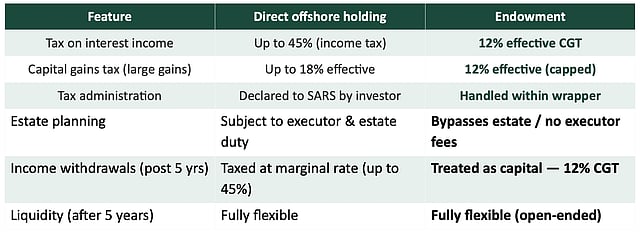
This does two things. First, it reduces the tax rate on your returns from up to 45% to a maximum effective rate of 12% on capital gains. Second, it puts you in control of when the tax bill arrives.
Think of it this way. In a direct offshore account, SARS is a silent partner drawing up to 45 cents from every rand of interest you earn, every single year. Inside the wrapper, that silent partner steps back and waits until you decide to exit.
Inside the endowment, capital gains tax is applied at a flat effective rate of 12%, regardless of the size of the gain. There is no marginal rate creep. No interaction with your other income. No risk of the rate climbing as your portfolio grows.
Direct holding vs endowment
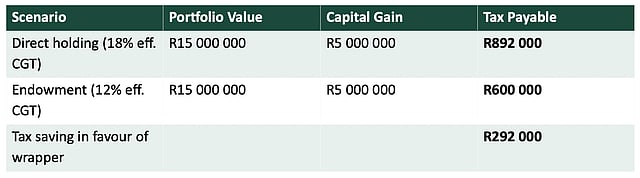
The numbers: CGT on R5m gain — Direct vs wrapper
What happens to your estate
The tax efficiency is compelling on its own. But the estate planning benefits are where we see some of the most significant savings, and where unstructured offshore holdings can cause the most damage.
Assets held directly offshore, whether shares in foreign companies, foreign unit trusts, or foreign bank accounts, may be subject to estate taxes in the country where they are held.
Add foreign probate processes, potential delays, and executor fees in the foreign jurisdiction, and the cost of getting this wrong becomes very real.
Assets held within the endowment sit outside your dutiable estate in South Africa. They bypass the executor entirely, which means no executor fees of up to 3.5% of the asset value on those funds. Your nominated beneficiaries receive the proceeds directly, paid in the currency and account of their choice, net of the 12% tax already settled within the policy.
If a beneficiary would rather keep the policy running than take a cash payout, they can take over ownership of the policy. The capital gains tax rolls over, deferring the liability further.
After five years, full flexibility
It’s important to mention that the endowment does have an initial five-year restriction period. This is a standard feature of sinking fund policies under South African insurance legislation, and it limits certain withdrawals during that time.
These might seem like strict restrictions, but for investors with a medium to long-term horizon, they’re rarely a practical obstacle.
Once that five-year period is up, the policy is fully open-ended. You can make regular withdrawals, switch between funds freely, and manage the portfolio as your circumstances change. And those withdrawals are treated as capital in nature, taxed at 12%, not at your marginal income tax rate of up to 45%.
Is this right for you?
The endowment isn’t for everyone. It’s specifically designed for investors with a marginal tax rate above 30% and a medium to long-term investment horizon. If that describes your situation, the cost of not using it is measurable, and in many cases, substantial.
As with all investment decisions, your specific circumstances matter. We’d encourage you to get in touch so we can look at how this structure could work for your portfolio.
*Ruan Breed is a financial advisor at Brenthurst Stellenbosch and serves the Limpopo and Mpumalanga provinces.


 Megan joined the Brenthurst Wealth team in March 2026 as an Administrative and Fiduciary Services Assistant at our Val de Vie Office in the Western Cape. Prior to joining Brenthurst, Megan gained three years of experience in the retail sector, where she developed management and client service skills.


 I obtained my National Diploma in Financial Information Systems from the Cape Peninsula University of Technology in 1999 and have worked in the wealth management industry since January 2000. Over the years, I have gained extensive experience in various roles, including Portfolio Manager Assistant, Planner Assistant, and Paraplanner.
 Esmarelda Isaacs-Andreas joined the Brenthurst Wealth Stellenbosch office in October 2025, taking on the dual role of Receptionist and Fiduciary Administrator.
 I obtained my National Diploma in Financial Information Systems from the Cape Peninsula University of Technology in 1999 and have worked in the wealth management industry since January 2000. Over the years, I have gained extensive experience in various roles, including Portfolio Manager Assistant, Planner Assistant, and Paraplanner.
 Ashley joined Brenthurst Wealth in January 2025 as Office Administrative Assistant and Receptionist for the Stellenbosch Office.


 René Heystek joined Brenthurst Wealth in November 2023, as receptionist and administrative assistant in the newly established George/Garden Route office.
 Michelle Heystek has built a career in the financial services over the last two decades, after obtaining her B.Com degree in Financial Management in 2005. Once she joined Brenthurst in 2006, she continued her academic journey, obtaining her Certificate in Wealth Management from INSETA in 2007, followed by a Postgraduate Diploma in Financial Planning from the University of the Free State. In 2008, she earned the Certified Financial Planner (CFP®) designation.


 Anelle joined Brenthurst Wealth as a Receptionist and Administrative Assistant to Brian Butchart in the Cape Town office in December 2023. She has a wealth of knowledge from working as a liaison between Financial Advisers and clients at TMA and Absa Investment Management Services (Aims) since 1998. She obtained her B. com degree from the University of Port Elizabeth in 1997.


 ADMITTED ATTORNEY | FINANCIAL PLANNER & HEAD OF BRENTHURST FOURWAYS

 Sanet was appointed in April 2020, joining our Cape Town team as an Executive Administration Assistant to Renee Eagar. She has been in the financial services industry since 1990. Her previous experience includes positions at Sanlam, BJM and ABSA. She spent her last 12 years working at Alexander Forbes Private Client Wealth as a Senior Wealth Management Assistant. She has received numerous accolades over the years which include but not limited to, Alexander Forbes Client Service Excellence – Silver award in 2014,2015 and 2017. Sanet has also obtained her Certificate in Wealth Management (NQF 5) in 2012 and achieved “Best Student of the Year” from Moonstone.


 Maria Smit is a Certified Financial Planner® with over 10 years of experience in the financial planning industry.