One of the biggest hurdles every investor faces is emotion. Because it’s just as easy to feel invincible when markets rise as it is to sell in panic when markets fall.
However, I want to make the case for just riding it out: the highs, and the lows. Because it’s been proven that you can only benefit from removing emotion from your investment decisions.
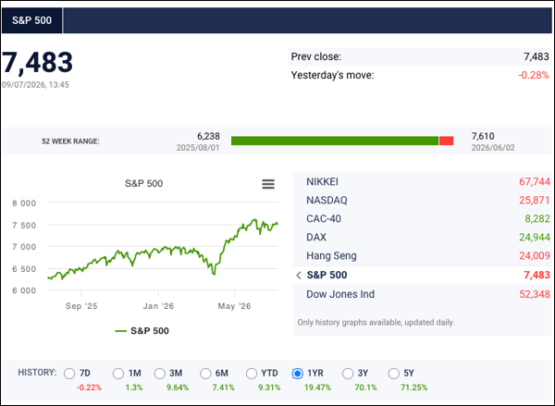
Staying invested for longer is simply the best way to grow your wealth over time. Just have a look at the returns in the S&P 500 over the past five years. By early July this year, the index was up more than 70%. Over one year, that growth was a still impressive 19%.
Source: Moneyweb
What this shows is that the longer you stay invested, the better the chances of higher returns. More importantly, this equation ignores the growth you need to recover losses if you sold when the market fell.
The cost of recovering losses
It’s important to accept that markets go up and they go down. It’s what you do when this happens that’s most important, because selling when markets fall lock in your losses.
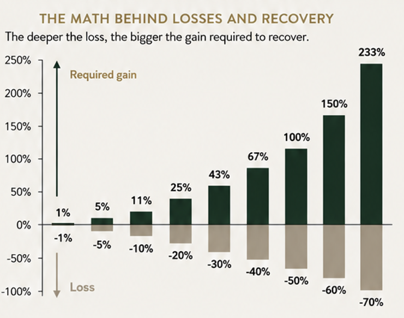
Look at this graph to see how this impacts your ability to recover, because the deeper the loss, the bigger the gain you need to recover it.
A 10% loss doesn’t need a 10% gain to break even. It needs 11%. A 20% loss needs 25%. A 50% loss needs 100%.
Source: LinkedIn
The danger of switching to money market after a fall
One of the biggest mistakes you can make is switching to cash after the market has already fallen. It feels safe, but it usually isn’t.
As shown in the graph, you need exceptional returns to recover your capital if you’ve sold at a low point.
Let’s say your R1 000 000 investment falls 20%, to R800 000. If you stay invested, a 25% recovery would take you back to R1 000 000.
But if you switch that R800 000 to a money market, and you might be earning interest, but also possibly miss the recovery entirely.
Even a steady money market return can leave you sitting well below your original value while the market has already turned. That’s the quiet danger of cash: it feels calm, but it gets expensive fast if it keeps you out of the recovery.
Staying invested doesn’t mean doing nothing
Staying the course doesn’t mean sitting on your hands. It means having a strategy in place before the market falls, not scrambling for one once it has.
Here’s the practical part.
Money you’ll need soon shouldn’t be sitting in equities. Put it in cash, income funds, or a money market account instead.
Your long-term money is different: give it time, and it grows. Equities will bounce around in the short term. Over the long term, they’re still one of the best wealth-builders you’ve got.
A good plan does three things. It spreads your risk. It gets reviewed regularly. And it gives every rand a job to do. Your short-term money keeps you stable. Your long-term money builds your wealth. Mix the two up when markets get scary, and that’s when the real damage happens.
The real lesson
The graph makes one thing clear: losses take patience to recover. The bigger the fall, the more it costs you to make an emotional decision at the wrong time.
Switching to money market after a fall may feel safe, but it can lock in your loss and leave you watching from the sidelines when the recovery starts. In most cases, the better move is to review your plan, rebalance where needed, and give your long-term investments the time they need.
Successful investing was never about avoiding every correction. It’s about being positioned to survive them, recover from them, and be there for the growth that follows.
Markets reward discipline more often than drama, and drama, unfortunately, does not compound. The trick for investors is to recognise the risk you pose to your own financial future by making knee-jerk decisions.
You don’t beat fear with willpower. You beat it with confidence, knowing your plan is right. That’s exactly what a good financial adviser gives you: an outside view, without the emotion attached.


 Megan joined the Brenthurst Wealth team in March 2026 as an Administrative and Fiduciary Services Assistant at our Val de Vie Office in the Western Cape. Prior to joining Brenthurst, Megan gained three years of experience in the retail sector, where she developed management and client service skills.


 I obtained my National Diploma in Financial Information Systems from the Cape Peninsula University of Technology in 1999 and have worked in the wealth management industry since January 2000. Over the years, I have gained extensive experience in various roles, including Portfolio Manager Assistant, Planner Assistant, and Paraplanner.
 Esmarelda Isaacs-Andreas joined the Brenthurst Wealth Stellenbosch office in October 2025, taking on the dual role of Receptionist and Fiduciary Administrator.
 I obtained my National Diploma in Financial Information Systems from the Cape Peninsula University of Technology in 1999 and have worked in the wealth management industry since January 2000. Over the years, I have gained extensive experience in various roles, including Portfolio Manager Assistant, Planner Assistant, and Paraplanner.
 Ashley joined Brenthurst Wealth in January 2025 as Office Administrative Assistant and Receptionist for the Stellenbosch Office.


 René Heystek joined Brenthurst Wealth in November 2023, as receptionist and administrative assistant in the newly established George/Garden Route office.
 Michelle Heystek has built a career in the financial services over the last two decades, after obtaining her B.Com degree in Financial Management in 2005. Once she joined Brenthurst in 2006, she continued her academic journey, obtaining her Certificate in Wealth Management from INSETA in 2007, followed by a Postgraduate Diploma in Financial Planning from the University of the Free State. In 2008, she earned the Certified Financial Planner (CFP®) designation.


 Anelle joined Brenthurst Wealth as a Receptionist and Administrative Assistant to Brian Butchart in the Cape Town office in December 2023. She has a wealth of knowledge from working as a liaison between Financial Advisers and clients at TMA and Absa Investment Management Services (Aims) since 1998. She obtained her B. com degree from the University of Port Elizabeth in 1997.


 ADMITTED ATTORNEY | FINANCIAL PLANNER & HEAD OF BRENTHURST FOURWAYS

 Sanet was appointed in April 2020, joining our Cape Town team as an Executive Administration Assistant to Renee Eagar. She has been in the financial services industry since 1990. Her previous experience includes positions at Sanlam, BJM and ABSA. She spent her last 12 years working at Alexander Forbes Private Client Wealth as a Senior Wealth Management Assistant. She has received numerous accolades over the years which include but not limited to, Alexander Forbes Client Service Excellence – Silver award in 2014,2015 and 2017. Sanet has also obtained her Certificate in Wealth Management (NQF 5) in 2012 and achieved “Best Student of the Year” from Moonstone.


 Maria Smit is a Certified Financial Planner® with over 10 years of experience in the financial planning industry.