
Over the last 10 years, SA investors have not been rewarded for taking equity-type risk if most of their wealth was invested in the JSE. Smart investors have started considering alternatives and flows to offshore markets, seeking better opportunities for long-term investors. The number of delistings on the JSE is increasing, and local fund managers could be under pressure to perform for their investors with fewer stocks available to buy.
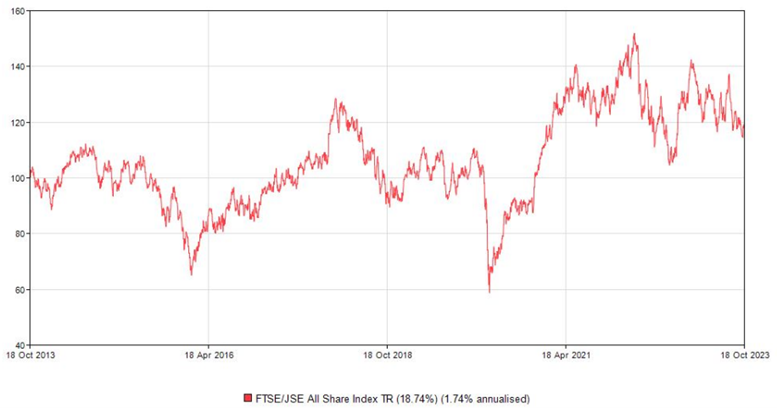
You could argue that if you track the returns of the JSE over a longer period than 10 years, you’d discover some sort of “acceptable” return to compensate a long-term investor. However, an annualised return of 1.74% from the JSE over 10 years should be unpleasing to investors who have committed to remaining invested for long periods of time and have accepted the levels of risk associated with equities.
The bull run during the Covid-19 pandemic was mainly due to strong performance from commodity stocks. These stocks benefited from rising commodity prices during the pandemic, as demand for commodities increased from China and other emerging markets.
Returns from the JSE over 10 years: Unable to beat inflation. The risk taken was not rewarded with returns.
Source: Profile Data/Highcharts.com
SA’s debt crisis: Government’s inability to create economic growth prospects.
In recent weeks, news headlines have dominated the financial media over the ever-rising fiscal debt crisis in SA, and a further $1 billion is being negotiated at the World Bank for investment into the failing energy sector. A recent publication in Business Day suggests that SA’s widening budget deficit raises the prospect of a fiscal crisis.
Although developed economies such as the US, too, have high fiscal debt levels, unemployment is low, and therefore, the economy still thrives as consumer demand remains resilient. This is not the same for South Africa, as the country’s unemployment rate is one of the highest in the world.
How does a possible fiscal crisis impact the South African economy? The crisp and short answer is that besides the borrowing cost of this debt exceeding R1 billion per day, it means that the government cannot allocate finances to stimulus projects to create employment as well as economic growth opportunities. This, too, poses a risk of wealth tax, exchange control tightening, and higher taxes, which will be felt by businesses and consumers.
South Africa and the rest of the world: We need foreign investment inflows and higher export numbers
South Africa is a commodity-producing economy, and being an open economy, the reliance of the rest of the world for stability and growth is big. Recent numbers indicate that foreigners are net sellers of South African equities and bonds. This creates less demand for the rand, and more demand for other developed market currencies, overall contributing to gradual rand weakness over time. This, together with slowed down exports of SA commodities to major trading partners such as China, places pressure on fiscal revenue collection, negatively impacts commodity prices, and again contributes to a weaker rand.
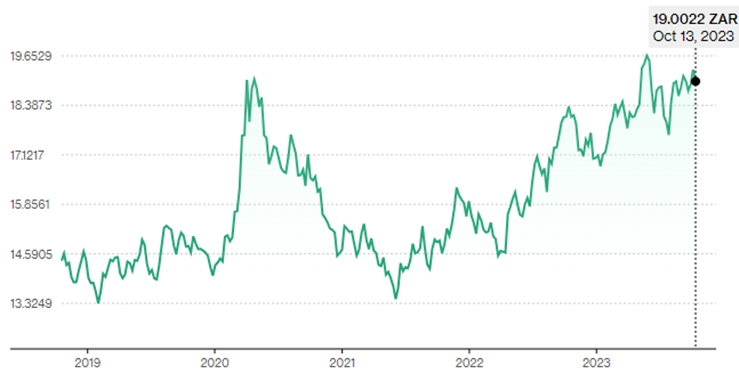
Here is how the rand has weakened over time: Rand depreciation is not good for foreign investors
On average, the rand weakened against the USD over the long term. This is unfavourable for foreign investors, as they earn less in USD or in their equivalent foreign currency terms.
Source: Bloomberg
Offshore investing remains a crucial part of a diversification strategy, and investors should take careful consideration to consider diversification away from the fragile SA economy and stock market in search of better opportunities, especially for long-term capital that is not required to service lifestyle needs.
All investment decisions are best decided with the guidance of a trusted wealth advisor.


 Megan joined the Brenthurst Wealth team in March 2026 as an Administrative and Fiduciary Services Assistant at our Val de Vie Office in the Western Cape. Prior to joining Brenthurst, Megan gained three years of experience in the retail sector, where she developed management and client service skills.


 I obtained my National Diploma in Financial Information Systems from the Cape Peninsula University of Technology in 1999 and have worked in the wealth management industry since January 2000. Over the years, I have gained extensive experience in various roles, including Portfolio Manager Assistant, Planner Assistant, and Paraplanner.
 Esmarelda Isaacs-Andreas joined the Brenthurst Wealth Stellenbosch office in October 2025, taking on the dual role of Receptionist and Fiduciary Administrator.
 I obtained my National Diploma in Financial Information Systems from the Cape Peninsula University of Technology in 1999 and have worked in the wealth management industry since January 2000. Over the years, I have gained extensive experience in various roles, including Portfolio Manager Assistant, Planner Assistant, and Paraplanner.
 Ashley joined Brenthurst Wealth in January 2025 as Office Administrative Assistant and Receptionist for the Stellenbosch Office.


 René Heystek joined Brenthurst Wealth in November 2023, as receptionist and administrative assistant in the newly established George/Garden Route office.
 Michelle Heystek has built a career in the financial services over the last two decades, after obtaining her B.Com degree in Financial Management in 2005. Once she joined Brenthurst in 2006, she continued her academic journey, obtaining her Certificate in Wealth Management from INSETA in 2007, followed by a Postgraduate Diploma in Financial Planning from the University of the Free State. In 2008, she earned the Certified Financial Planner (CFP®) designation.


 Anelle joined Brenthurst Wealth as a Receptionist and Administrative Assistant to Brian Butchart in the Cape Town office in December 2023. She has a wealth of knowledge from working as a liaison between Financial Advisers and clients at TMA and Absa Investment Management Services (Aims) since 1998. She obtained her B. com degree from the University of Port Elizabeth in 1997.


 ADMITTED ATTORNEY | FINANCIAL PLANNER & HEAD OF BRENTHURST FOURWAYS

 Sanet was appointed in April 2020, joining our Cape Town team as an Executive Administration Assistant to Renee Eagar. She has been in the financial services industry since 1990. Her previous experience includes positions at Sanlam, BJM and ABSA. She spent her last 12 years working at Alexander Forbes Private Client Wealth as a Senior Wealth Management Assistant. She has received numerous accolades over the years which include but not limited to, Alexander Forbes Client Service Excellence – Silver award in 2014,2015 and 2017. Sanet has also obtained her Certificate in Wealth Management (NQF 5) in 2012 and achieved “Best Student of the Year” from Moonstone.


 Maria Smit is a Certified Financial Planner® with over 10 years of experience in the financial planning industry.


