GLOBAL MARKETS
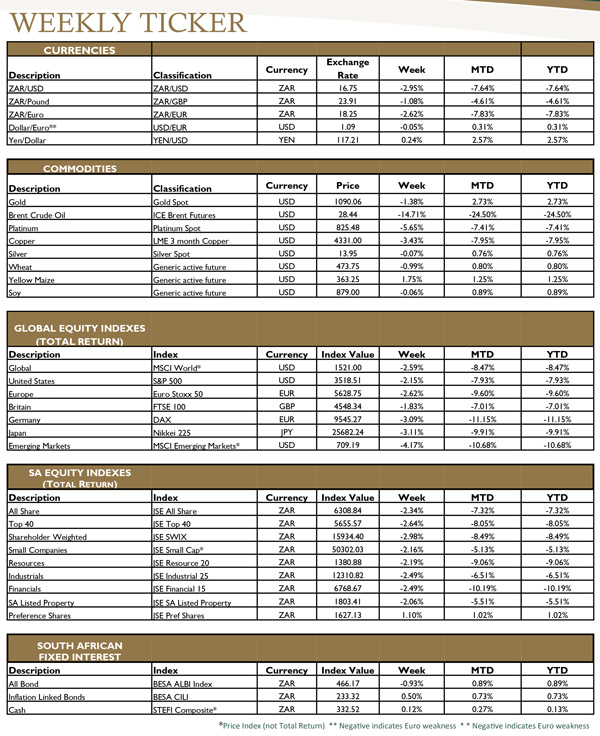
It has certainly been a volatile start to the 2016 year. In contrast to the so called January effect, which refers to the tendency of stocks to rally in January, many markets are already off to a negative start with concerns over the global environment fueling risk aversion and safe-haven trades. Fears over a struggling China have exacerbated this. While uncertainty remains, volatility should be expected with gold, the USD and treasuries benefitting from risk-off trade.
For 2016, the World Bank forecasts global economic growth of 2.9%, down from 3.3% six months ago. The lower growth forecast can mainly be attributed to the slowdown in China, Russia and Brazil. The World Bank is of the opinion that in 2016, EMs could face the worst year since the 2008 economic crisis. EM economies grew at a pace of 4.3% in 2015, the slowest since 2009.
China remains a key factor in the negative global sentiment. Sparked by a depreciation of the Chinese Yuan (CNY) by the PBoC, the Shanghai Shenzhen CSI 300 Index dropped over 7% on two separate days, triggering a circuit breaker rule which halted any further equity trading for the day. This led to turmoil in global markets but authorities have since abandoned the circuit breaker rule, restoring some confidence. Chinese equity markets are now allowed to run more freely but stock sales by major shareholders (investors with stakes exceeding five percent of a company) are still not allowed to sell for the next six months. The CSI 300 Index is down 15.7% year-to-date.
As the slowdown in China continues, commodities remain on the back foot. Brent crude fell below USD30/bbl for the first time since 2004 this past week. While the fall is certainly linked to fears over China, overproduction is also having a significant effect. Historically, oil production has been tightly controlled by OPEC but at the end of last year OPEC failed to reach a decision to cut supply. With escalating tensions between Iran and Saudi Arabia, a near term solution seems unlikely.
Another major theme for the year ahead will be rate hikes in the US, or rather the pace at which these occur. From the latest minutes of the December FOMC meeting, it seems the Fed remains split on the inflation and economic outlook. While the decision to hike rates at the last meeting was unanimous, the Fed will continue on their cautious approach to policy normalisation and rate hikes will be implemented slowly to support the labour market and inflation.
Most markets ended the week negatively, with EMs taking more pain than DMs. The MSCI World Index ended 2.6% down and the MSCI EM Index was down 4.2% for the week.
DOMESTIC MARKETS
Monday saw the rand plummet to reach a record intraday low of ZAR/USD 17.91. The rand has since recovered somewhat, closing the week at ZAR/USD 16.75; however the Rand is still 15% lower than levels seen prior to President Zuma’s sacking of finance minister Nene. While the re-appointment of Pravin Gordhan has reversed some of the damage, the confidence lost is not completely restored.
Arguably oversold, it is difficult to see any significant improvements to the rand in the short term. In addition to domestic issues of poor growth, political uncertainty and structural problems, South Africa is also facing external pressures from China, the commodity cycle and Fed interest rate hikes. With similar external pressures, other emerging market economies have also suffered of late. However, the Rand has been the worst performing EM currency year-to-date (down over 7%). This clearly illustrates the negative effect local conditions are having.
We are looking for a tough year. Downgrades to GDP and consensus earnings are likely, and a possible S&P downgrade to junk status will be a key event to watch in June this year. Both S&P and Fitch have a BBB- rating for SA’s foreign currency long-term debt, (which is one notch above sub-investment grade), but while Fitch have a “stable” outlook, S&P have SA on “negative” watch. This implies a downgrade by S&P is plausi-ble unless the country’s growth and debt dynamics improve.
In addition to a looming downgrade, South Africa is also likely facing interest rate hikes as a consequence of inflationary pressures. Currently the market is pricing in a 25 bps hike at the next SARB meeting (on 28 January) but a 50 bps hike cannot be ruled out. While inflation has remained low over the past year, the effects of a weaker rand and rising food inflation are expected to push CPI through the 6% upper target band. However, largely owing to the oil price, (which is 22% weaker than it was a month ago), the pass through inflationary effects remain fairly muted for now and this should hopefully allow the SARB to stick with its policy of gradualism.
Welcomed rains are finally starting to occur in parts of the country; which may unfortunately be too late to save struggling farmers. SA is facing the worst drought since 1992 and according to the Department of Water Affairs; South African dams were only 57% full at the start of the year compared to 82% a year ago.
The dry conditions will lead to significant shortages in production and Agri SA executive director Omri van Zyl believes a record R15bn to R20bn could be needed to see farmers through the tough conditions. Grain SA also stated that the maize harvest this year will be about 5m tons, less than half of the country’s needs. Although water restrictions have been implemented across the country, there is talk of increasing water prices in order to further curb consumption. This will add to pressure on both businesses and consumers.
On a slightly more optimistic note, the weak rand is starting to show some benefits. According to the Department of Home Affairs, the number of foreign visitors increased 7.6% over the festive season, a marked improvement on negative numbers reported in the first three quarters of 2015 by Stats SA. The depreciation of the currency should also, in time, start to show benefits through a boost in exports.
Most local indices ended the week negatively. Year-to-date, resources and financials remain the hardest hit and the All Share and SWIX Indices are down 7.3% and 8.5% respectively.




 Megan joined the Brenthurst Wealth team in March 2026 as an Administrative and Fiduciary Services Assistant at our Val de Vie Office in the Western Cape. Prior to joining Brenthurst, Megan gained three years of experience in the retail sector, where she developed management and client service skills.


 I obtained my National Diploma in Financial Information Systems from the Cape Peninsula University of Technology in 1999 and have worked in the wealth management industry since January 2000. Over the years, I have gained extensive experience in various roles, including Portfolio Manager Assistant, Planner Assistant, and Paraplanner.
 Esmarelda Isaacs-Andreas joined the Brenthurst Wealth Stellenbosch office in October 2025, taking on the dual role of Receptionist and Fiduciary Administrator.
 I obtained my National Diploma in Financial Information Systems from the Cape Peninsula University of Technology in 1999 and have worked in the wealth management industry since January 2000. Over the years, I have gained extensive experience in various roles, including Portfolio Manager Assistant, Planner Assistant, and Paraplanner.
 Ashley joined Brenthurst Wealth in January 2025 as Office Administrative Assistant and Receptionist for the Stellenbosch Office.



 René Heystek joined Brenthurst Wealth in November 2023, as receptionist and administrative assistant in the newly established George/Garden Route office.
 Michelle Heystek has built a career in the financial services over the last two decades, after obtaining her B.Com degree in Financial Management in 2005. Once she joined Brenthurst in 2006, she continued her academic journey, obtaining her Certificate in Wealth Management from INSETA in 2007, followed by a Postgraduate Diploma in Financial Planning from the University of the Free State. In 2008, she earned the Certified Financial Planner (CFP®) designation.


 Anelle joined Brenthurst Wealth as a Receptionist and Administrative Assistant to Brian Butchart in the Cape Town office in December 2023. She has a wealth of knowledge from working as a liaison between Financial Advisers and clients at TMA and Absa Investment Management Services (Aims) since 1998. She obtained her B. com degree from the University of Port Elizabeth in 1997.


 ADMITTED ATTORNEY | FINANCIAL PLANNER & HEAD OF BRENTHURST FOURWAYS

 Sanet was appointed in April 2020, joining our Cape Town team as an Executive Administration Assistant to Renee Eagar. She has been in the financial services industry since 1990. Her previous experience includes positions at Sanlam, BJM and ABSA. She spent her last 12 years working at Alexander Forbes Private Client Wealth as a Senior Wealth Management Assistant. She has received numerous accolades over the years which include but not limited to, Alexander Forbes Client Service Excellence – Silver award in 2014,2015 and 2017. Sanet has also obtained her Certificate in Wealth Management (NQF 5) in 2012 and achieved “Best Student of the Year” from Moonstone.


 Maria Smit is a Certified Financial Planner® with over 10 years of experience in the financial planning industry.