GLOBAL MARKETS
MARKETS STRENGTHENED ACROSS THE BOARD
Central bank intervention continues to dominate market performance as expectations of further monetary easing and/or weak growth influence sentiment. We have recently witnessed comments by both the ECB and the BoJ indicating further stimulus, resulting in bond yields declining even further and equities regaining some of the ground lost in the first few weeks of the year. At the time of writing, 13 developed markets are experiencing negative bond yields on two-year sovereign paper, with Japan, Germany and France experiencing negative yields out as far as 7 years.
Market attention this past week was focused on the US January employment report, with payroll data released on Friday. Non-farm payrolls came in worse than expected at 151k, against expectations of 190k. This is down from 292k in December and suggests the US economy is not growing as strongly as the Fed would like. While still in positive territory, US Bond yields continue to slide lower with expectations for a rate hike in March now below 10%. The US 10yr treasury is trading at 1.86%
In the UK, the BOE kept rates unchanged at 0.5%. However, while in line with expectations, the split of the vote for the bank rate decision was changed. Previously, out of the 9 voting members, 1 had consistently voted for a rate hike over the past six months. However the split this time was 9-0, and therefore not one member was in favor of an increase. It seems any near term rate hikes in the UK are unlikely.
The Reserve Bank of Australia (RBA) also kept its benchmark rate unchanged at 2%. However, with recent inflation data indicating that inflation remains below the 2% – 3% desired level, a near term rate cut is certainly not off the table. The RBA has already cut rates by 25bps twice in the last 12 months.
In China, PMI numbers were released for January, reinforcing the view that the manufacturing side of the economy remains under pressure, however that services are benefiting from monetary stimulus. Manufacturing PMI came in at 49.4, slightly lower than expectations and down from 49.7 in December. This latest print indicates that the manufacturing sector has now been in contraction for six months. In contrast, Chinese services PMI came in at 52.4 for January, up from 50.2 the previous month and putting the index at a six month high.
The Chinese fiscal deficit was also released, indicating the slowdown in the economy may be starting to weigh on fiscal policy too. The fiscal deficit widened from -2.1% of GDP in 2014 to -3.5% of GDP in 2015. Up to last year, the preferred method of stimulating spending in the Chinese economy had been through credit growth but it seems authorities may now be attempting to use fiscal policy as an alternative method.
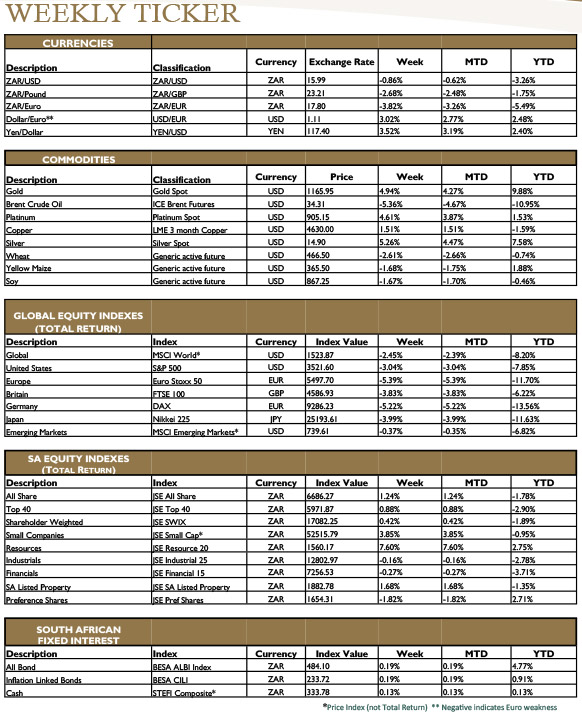
Amidst a highly uncertain world of worsening economic fundamentals but increased liquidity, markets had a volatile week with EM outperforming DM (the MSCI EM Index was down 0.4% w/w against the MSCI World Index, down 2.5% w/w). Resources and in particular gold were among the top performers with oil under pressure once again. Gold is now trading at USD1165, putting the oil/gold ratio at its cheapest since 1988.
DOMESTIC MARKETS
PRESSURE ON GORDHAN FOR STRONG BUDGET
South Africa has benefited of late from the more risk-on environment and many of the losses witnessed in the first few weeks of the year have begun to be recouped. Although still negative year-to-date, the JSE All Share Index was up 1.2% w/w with resource shares being the star performers, the JSE Resource 20 Index up 7.6% w/w. The Rand too has regained some strength and while still suffering consequences from the Finance Minister debacle, it seems to be trading just below the ZAR/USD 16.00 level.
Barclay’s manufacturing PMI and vehicle sales numbers were released, both suggesting the economy started 2016 on a very weak note. The manufacturing PMI fell for a sixth consecutive month to 43.5. Manufacturing is the fourth biggest contributor to GDP and as inventories continue to outstrip new orders, production will remain muted, adding further constrains to economic growth and likely leading to further job cuts. Vehicle sales fell more than expected, dropping 6.9% y/y. In particular, passenger car sales which are a good proxy for consumer demand dropped 5.5% y/y.
Near term electricity tariff hikes are likely to be implemented, adding further strain to the consumer. After being the center of attention for a substantial part of the 2015 year, news surrounding Eskom has been much quieter of late with rolling blackouts having only occurred once in the past six months. However, Eskom remains in a battle to recover costs, applying to the National Energy Regulator of South Africa (NERSA) for tariff increases to cover R22.8bn in expenditure overruns and revenue shortfalls. If NERSA grants the entire application, it could lead to electricity price increases of over 16% in April and July, roughly double the 8% agreed at the multiyear price determination process. NERSA was due to close their hearings on Friday and we can expect the outcome of their decision shortly. With the electricity provider’s ability to supply power having stabilised, Eskom has indicated that it is unlikely to implement rolling blackouts for the rest of the summer and winter.
The above indicates that while South Africa may be benefitting from a more positive investor sentiment environment, fundamentals still remain weak. This past week, the World Bank joined the growing number of institutions to lower their growth forecast for South Africa, stating the country is “flirting with recession.” GDP growth is forecast at 0.8% for 2016 (down from 1.4%) and at 1.1% for 2017 (down from 1.6%). According to the Bank, South Africa will need to grow by 7.2% from 2018 in order to meet objectives set out in the National Development Plan.
Finance Minister Pravin Gordhan has promised to deliver a strong budget policy review at the end of the month in an attempt to grow the economy while maintaining fiscal consolidation. Speculation is that the budget will involve income tax increases as well as expenditure cuts.
This upcoming week, the political calendar kicks off with the opening of parliament and the President’s State of the Nation Address (SONA) on Thursday, an important precursor to the Budget Review on 24 February. While the SONA does not typically address policy issues covered in the Budget, President Zuma is expected to comment on the current environment, largely as an attempt to regain some lost support from the Nene debacle.



 Megan joined the Brenthurst Wealth team in March 2026 as an Administrative and Fiduciary Services Assistant at our Val de Vie Office in the Western Cape. Prior to joining Brenthurst, Megan gained three years of experience in the retail sector, where she developed management and client service skills.


 I obtained my National Diploma in Financial Information Systems from the Cape Peninsula University of Technology in 1999 and have worked in the wealth management industry since January 2000. Over the years, I have gained extensive experience in various roles, including Portfolio Manager Assistant, Planner Assistant, and Paraplanner.
 Esmarelda Isaacs-Andreas joined the Brenthurst Wealth Stellenbosch office in October 2025, taking on the dual role of Receptionist and Fiduciary Administrator.
 I obtained my National Diploma in Financial Information Systems from the Cape Peninsula University of Technology in 1999 and have worked in the wealth management industry since January 2000. Over the years, I have gained extensive experience in various roles, including Portfolio Manager Assistant, Planner Assistant, and Paraplanner.
 Ashley joined Brenthurst Wealth in January 2025 as Office Administrative Assistant and Receptionist for the Stellenbosch Office.



 René Heystek joined Brenthurst Wealth in November 2023, as receptionist and administrative assistant in the newly established George/Garden Route office.
 Michelle Heystek has built a career in the financial services over the last two decades, after obtaining her B.Com degree in Financial Management in 2005. Once she joined Brenthurst in 2006, she continued her academic journey, obtaining her Certificate in Wealth Management from INSETA in 2007, followed by a Postgraduate Diploma in Financial Planning from the University of the Free State. In 2008, she earned the Certified Financial Planner (CFP®) designation.


 Anelle joined Brenthurst Wealth as a Receptionist and Administrative Assistant to Brian Butchart in the Cape Town office in December 2023. She has a wealth of knowledge from working as a liaison between Financial Advisers and clients at TMA and Absa Investment Management Services (Aims) since 1998. She obtained her B. com degree from the University of Port Elizabeth in 1997.


 ADMITTED ATTORNEY | FINANCIAL PLANNER & HEAD OF BRENTHURST FOURWAYS

 Sanet was appointed in April 2020, joining our Cape Town team as an Executive Administration Assistant to Renee Eagar. She has been in the financial services industry since 1990. Her previous experience includes positions at Sanlam, BJM and ABSA. She spent her last 12 years working at Alexander Forbes Private Client Wealth as a Senior Wealth Management Assistant. She has received numerous accolades over the years which include but not limited to, Alexander Forbes Client Service Excellence – Silver award in 2014,2015 and 2017. Sanet has also obtained her Certificate in Wealth Management (NQF 5) in 2012 and achieved “Best Student of the Year” from Moonstone.


 Maria Smit is a Certified Financial Planner® with over 10 years of experience in the financial planning industry.