GLOBAL MARKETS
MANUFACTURING CONTINUES TO SHRINK IN CHINA
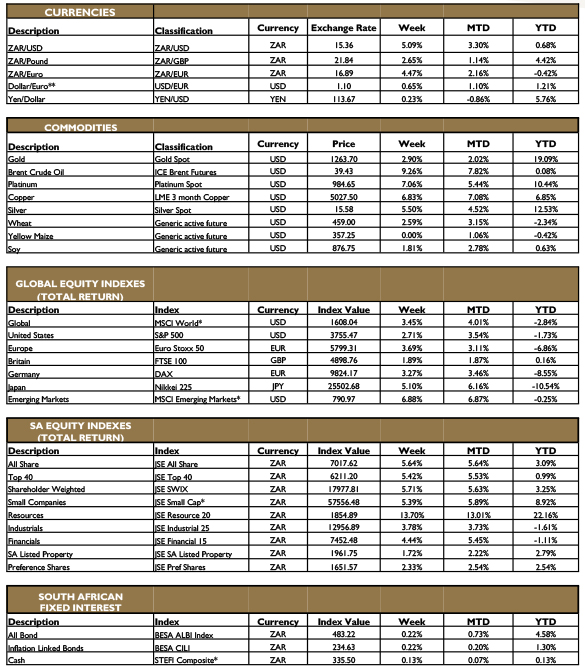
Boosted by the PBoC announcing a 50bps cut in the reserve requirement ratio and the increased likelihood of further policy easing by the ECB, global sentiment has improved which saw EM markets and currencies benefitting this past week. Strong employment numbers out of the US also added to the positive outlook, all causing commodities to rally. The MSCI EM Index closed up 6.9% w/w and platinum and Brent oil were up 7.1% and 9.3% respectively, the highest levels seen since the start of the year.
In China, the manufacturing sector continues to shrink. The manufacturing PMI fell to 49 in February from 49.4 the previous month. While still in an expansionary phase (above 50), China’s services PMI also declined to 52.7 in February from 53.5 in January. In reaction, the PBoC lowered its bank reserve requirement ratio (RRR) by 50bps to 17% for major commercial lenders. The action should also help replenish some of the liquidity lost as a result of recent capital outflows. Importantly, the cut indicates that authorities are now prioritising growth over long-term credit risk and markets rallied on the news. However, the consequences of rising government debt, falling currency reserves and uncertainty over reforms led Moody’s to cut China’s outlook on government debt from stable to negative.
Japan for the first time ever placed a 10yr bond with a negative interest rate at a primary auction. In other words, the Japanese government is getting paid to borrow money for a decade. The BoJ introduced negative interest rates in January by charging banks on some of their deposits at the central bank and Japan is now the second country with 10yr bonds trading at a negative yield. With the down-ward force of global inflationary pressures, volatile capital markets, tightening financial conditions and slowing growth all influencing demand for such products, other countries may soon follow suit.
In the Euro Area, February headline inflation fell back below zero at -0.2% y/y after four months of positive readings. While the negative number can largely be attributed to the fall in oil prices, core infla-tion also fell to its lowest level since April 2015. Both readings remain well below the ECB’s target of 2% and reinforce the case for additional easing at the ECB meeting on 10 March.
US employment numbers were stronger than expected. Nonfarm payrolls rising 242k in February up from 151k the previous month against 195k expected. The Fed has continually reiterated its monetary policy stance is highly data dependent and although the market is not expecting a rate hike in March, the stronger than expected employment numbers will have increased expectations.
DOMESTIC MARKETS
RAND MOST UNDER-PRICED CURRENCY ON THE CONTINENT
According to the KFC Index reported by Sagaci Research, the Rand is the most underpriced currency on the continent. Inspired by the Big Mac Index, Sagaci Research has developed an index which analyses the prices of the Original Chicken Bucket from KFC across 18 African countries. However, even if it may be fundamentally undervalued from this perspective, the Rand continues to suffer from SA specific factors.
Since the Nene debacle, the Rand is the second worst performing currency among its EM peers. With risk back on the table and the SA political outlook slightly more stable, the Rand has regained some of these losses and appreciated 5.1% against the USD over the past week.The Rand closed the week at ZAR/USD 15.36.
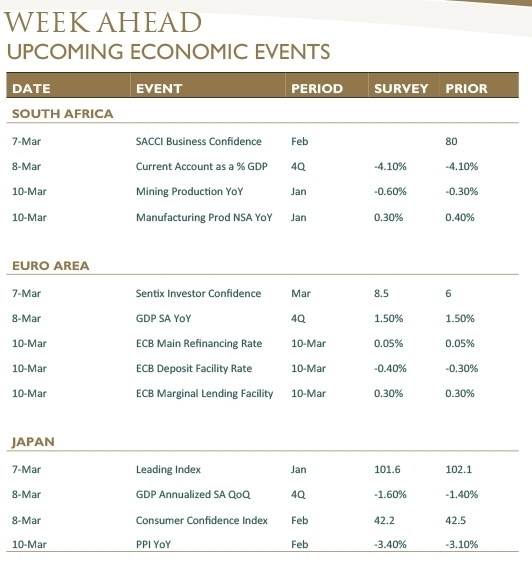
There are many different methods used to value a currency. The KFC Index is an example of the purchas-ing power parity (PPP) approach, which compares the cost of a similar basket of goods across different countries, and suggests the Rand is undervalued. However, according to another very well regarded approach, the Fundamental Equilibrium Exchange Rate (FEER), which calculates the level of the currency that produces a sustainable current account deficit, the Rand is in fact overvalued. Therefore, with both global and political uncertainty influencing short term movements, it is difficult to determine an outlook for the Rand in the short term. Regardless, the level of the current account remains a very important determi-nant and with the recent budget statement still front of mind, all eyes will be on the Q4 2015 current account data due on 8 March.
January merchandise trade data and budget deficit numbers were released, both delivering larger than expected deficits. The merchandise deficit was driven by a decline in exports of 18.8% m/m (largely ex-plained by low commodity prices) which outweighed the 11.0% m/m increase in imports. On the budget deficit, government revenue was strong, growing 19.7% y/y but expenditures were too, up 15.2% y/y.
While it is important to note that seasonal factors typically reflect deficits in the beginning of the year (particularly in the merchandise trade balance), the numbers do not paint a picture of a healthier current account deficit going forward. Q4 2015 GDP growth numbers were also released, coming out lower than expected at 0.6% q/q, printing the lowest rate since 2009.
The electricity regulator, NERSA, have not granted Eskom’s application for the R22.8bn regulatory clear-ing account which suggested an electricity tariff increase of around 12%. Instead, NERSA have granted Eskom a further R11.2bn in revenue for 2016/2017 which equates to a tariff increase of 9.4% from 1 April 2016. According to Eskom CEO Brian Molefe, the decision will have operational consequences, making it more difficult to keep the lights on in the upcoming winter months.
In line with global markets, risk-on trades saw a strong week across the board. The JSE All Share Index was up 5.6% w/w and leading the pack, resources (JSE Resource 20 Index) rallied 13.7% w/w.



 Megan joined the Brenthurst Wealth team in March 2026 as an Administrative and Fiduciary Services Assistant at our Val de Vie Office in the Western Cape. Prior to joining Brenthurst, Megan gained three years of experience in the retail sector, where she developed management and client service skills.


 I obtained my National Diploma in Financial Information Systems from the Cape Peninsula University of Technology in 1999 and have worked in the wealth management industry since January 2000. Over the years, I have gained extensive experience in various roles, including Portfolio Manager Assistant, Planner Assistant, and Paraplanner.
 Esmarelda Isaacs-Andreas joined the Brenthurst Wealth Stellenbosch office in October 2025, taking on the dual role of Receptionist and Fiduciary Administrator.
 I obtained my National Diploma in Financial Information Systems from the Cape Peninsula University of Technology in 1999 and have worked in the wealth management industry since January 2000. Over the years, I have gained extensive experience in various roles, including Portfolio Manager Assistant, Planner Assistant, and Paraplanner.
 Ashley joined Brenthurst Wealth in January 2025 as Office Administrative Assistant and Receptionist for the Stellenbosch Office.



 René Heystek joined Brenthurst Wealth in November 2023, as receptionist and administrative assistant in the newly established George/Garden Route office.
 Michelle Heystek has built a career in the financial services over the last two decades, after obtaining her B.Com degree in Financial Management in 2005. Once she joined Brenthurst in 2006, she continued her academic journey, obtaining her Certificate in Wealth Management from INSETA in 2007, followed by a Postgraduate Diploma in Financial Planning from the University of the Free State. In 2008, she earned the Certified Financial Planner (CFP®) designation.


 Anelle joined Brenthurst Wealth as a Receptionist and Administrative Assistant to Brian Butchart in the Cape Town office in December 2023. She has a wealth of knowledge from working as a liaison between Financial Advisers and clients at TMA and Absa Investment Management Services (Aims) since 1998. She obtained her B. com degree from the University of Port Elizabeth in 1997.


 ADMITTED ATTORNEY | FINANCIAL PLANNER & HEAD OF BRENTHURST FOURWAYS

 Sanet was appointed in April 2020, joining our Cape Town team as an Executive Administration Assistant to Renee Eagar. She has been in the financial services industry since 1990. Her previous experience includes positions at Sanlam, BJM and ABSA. She spent her last 12 years working at Alexander Forbes Private Client Wealth as a Senior Wealth Management Assistant. She has received numerous accolades over the years which include but not limited to, Alexander Forbes Client Service Excellence – Silver award in 2014,2015 and 2017. Sanet has also obtained her Certificate in Wealth Management (NQF 5) in 2012 and achieved “Best Student of the Year” from Moonstone.


 Maria Smit is a Certified Financial Planner® with over 10 years of experience in the financial planning industry.