For generations, one had to frequent the local golf course for the hottest stock picks and investment tips. The internet has forever changed the retail investor landscape and individual investors now have a wealth of information to call upon when making investment decisions. The democratisation of investing has meant savvy investors are able to access investment opportunities that were only accessible to the privileged few, without costing the arm and leg that past generations had to fork out to financial intermediaries.
For less savvy investors, the rise in information means they are adrift in a sea of “clickbait”. On the one side of the spectrum, you have news agencies constantly suggesting a recession is around the corner, couple that with teenagers making millions by selling digital pictures of apes online and peers profiting by getting in early on the latest “get rich quick scheme”. Add assets like cryptocurrencies to the mix and the rise in social media to document all of this means that both investors’ anxiety and expectation have gone through the roof.
For those who do not have the time or expertise to process the information overload and differing opinions and predictions, these three points of guidance, coupled with an engagement with an investment professional, can set their investment journey on the right path:
1. Return expectations
Investors must rein in expectations, which is easier said than done when surrounded by >1 000% gains made from cryptocurrencies and peers profiting from investing in the shares of companies like Tesla ($62.81 per share in April 2017, $1 005.05 per share this month) or JSE star performer in recent months Thungela Resources (R29 per share in June 2021, now at R246 per share). Overnight success stories gain a disproportionate amount of airtime on social media, creating the misperception for many everyday investors that this is the norm. In fact, it is far from it, as the below table shows the annualised returns achieved by investing in the S&P 500 over a 50-year period from 1972 to 2021.
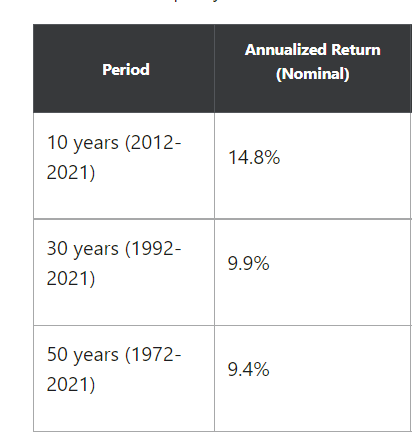
Source 1: Moneychimp, Motley Fool
To illustrate that investments do not go up in a straight line and that an investor’s best chance of success is to remain patient, see the below breakdown of annual returns of the S&P500. Although the average annualised return is roughly 10%, very rarely are returns in individual years close to the average.

Source: Moneychimp, Motley Fool and Brenthurst Wealth
But what does a return of 10% per annum mean for the investor? For an investor to double their money if an average return of 10% is achieved, the capital should remain invested for roughly seven years.
The power of compound interest can be explained by the following example:
Assume R1 million is invested in year 0 in the S&P500. We will assume the investment returns the historic average annualised return of 10%. The investor must wait 7.3 years for the investment to gain R1 million and double to R2 million. However, the power of compound interest is such that the investor must only wait 4.3 years to gain the next R1 million and reach R3 million in total.
2. Withdrawal rate during retirement
Many factors play a role in determining the monthly income you can draw from your investments once retired, a good starting point is the “4% rule” widely used in the investment industry. The “4% rule” states that an investor can draw 4% of their capital per annum – R40 000 per year, or R3 333 per month for every R1 million of capital. This 4% can then be increased annually with inflation to last for a period of 30 years.
Age, health, asset allocation etc. play a role in determining an individual investor’s sustainable withdrawal rate, but as the goal of the article is to provide clarity, the “4% rule” serves as a good anchor for investor expectations.
3. May the odds be in your favour
Cash and bonds are considered conservative investments, which according to history means lower returns and less volatility. Equities are considered risky investments, which means higher returns and more risk. Investing, however, remains a game of chance and it is advisable to tilt the balance of probabilities in your favour.
This can be done by giving your capital sufficient time to grow. The below graph shows how the probability of achieving growth increases as your holding period increases. Starting with a 70% chance for a 1-year holding period, rising to 80% after three years and reaching 95% in year eight.

Source: Macrobond; MSCI World Equity Mid and MSCI Large Cap Total Return in GBP, 1 January 1971-6 Dec 2021
This warns us that simply moving up the risk curve (investing more aggressively) later in your life in the hope to secure a better retirement does not guarantee success. As mentioned in lesson 1, equities do not go up in a straight line and although the potential for better returns exists, the balance of probabilities isn’t in your favour if your investment time horizon isn’t sufficient.
Nick Maggiulli puts it eloquently: “your gains are uncertain; your liabilities are guaranteed. If you need to spend money and you can’t, that’s risk. By this definition, investing what you can’t afford to lose might be the riskiest investment choice of all”.
There are many issues to consider when embarking on or updating an investment strategy. To make sense of the most appropriate approach for your personal circumstances, it is advisable to consult an experienced, qualified advisor.


 Megan joined the Brenthurst Wealth team in March 2026 as an Administrative and Fiduciary Services Assistant at our Val de Vie Office in the Western Cape. Prior to joining Brenthurst, Megan gained three years of experience in the retail sector, where she developed management and client service skills.


 I obtained my National Diploma in Financial Information Systems from the Cape Peninsula University of Technology in 1999 and have worked in the wealth management industry since January 2000. Over the years, I have gained extensive experience in various roles, including Portfolio Manager Assistant, Planner Assistant, and Paraplanner.
 Esmarelda Isaacs-Andreas joined the Brenthurst Wealth Stellenbosch office in October 2025, taking on the dual role of Receptionist and Fiduciary Administrator.
 I obtained my National Diploma in Financial Information Systems from the Cape Peninsula University of Technology in 1999 and have worked in the wealth management industry since January 2000. Over the years, I have gained extensive experience in various roles, including Portfolio Manager Assistant, Planner Assistant, and Paraplanner.

 Ashley joined Brenthurst Wealth in January 2025 as Office Administrative Assistant and Receptionist for the Stellenbosch Office.


 René Heystek joined Brenthurst Wealth in November 2023, as receptionist and administrative assistant in the newly established George/Garden Route office.

 Michelle Heystek has built a career in the financial services over the last two decades, after obtaining her B.Com degree in Financial Management in 2005. Once she joined Brenthurst in 2006, she continued her academic journey, obtaining her Certificate in Wealth Management from INSETA in 2007, followed by a Postgraduate Diploma in Financial Planning from the University of the Free State. In 2008, she earned the Certified Financial Planner (CFP®) designation.


 Anelle joined Brenthurst Wealth as a Receptionist and Administrative Assistant to Brian Butchart in the Cape Town office in December 2023. She has a wealth of knowledge from working as a liaison between Financial Advisers and clients at TMA and Absa Investment Management Services (Aims) since 1998. She obtained her B. com degree from the University of Port Elizabeth in 1997.


 ADMITTED ATTORNEY | FINANCIAL PLANNER & HEAD OF BRENTHURST FOURWAYS


 Sanet was appointed in April 2020, joining our Cape Town team as an Executive Administration Assistant to Renee Eagar. She has been in the financial services industry since 1990. Her previous experience includes positions at Sanlam, BJM and ABSA. She spent her last 12 years working at Alexander Forbes Private Client Wealth as a Senior Wealth Management Assistant. She has received numerous accolades over the years which include but not limited to, Alexander Forbes Client Service Excellence – Silver award in 2014,2015 and 2017. Sanet has also obtained her Certificate in Wealth Management (NQF 5) in 2012 and achieved “Best Student of the Year” from Moonstone.


 Maria Smit is a Certified Financial Planner® with over 10 years of experience in the financial planning industry.