In March, the JSE was up 40% and Magnus Heystek was eating humble pie on stage at our BizNews Conference in Hermanus. Would he bring money home? “Not one cent.” Six months later, he looks right. Gold has pulled back, Naspers is down 46% from its peak, and the JSE is 13% off its high. Global markets are up between 15% and 20% over the same stretch. Even other emerging markets have left South Africa behind. Heystek argues the rally was never broad-based. Ten years of “local is lekker” has cost investors dearly. R1m put into the Top 40 a decade ago is worth R3,1m today. In the Nasdaq it would be R8,3m. So what has patriotism cost us?
By Magnus Heystek*
In March this year, I was fortunate to speak at the Biznews Conference in Hermanus.
At the time, the 12-month returns on the JSE were an astonishing 40%, far outperforming all major markets in the world and making my long-held view that “offshore is better” look quite silly.
You could say I was eating humble pie.
As can be expected, the first question from the audience was whether I was about to change my long-held view and “bring some money back”.
“Not one cent,” I replied, then pointed out that the upward rush in the JSE was boosted by a small handful of shares, mostly gold shares and then Naspers/Prosus. Biznews and Daily Investor reported this.
In my view, there was no sign of a broad-based re-rating of SA Inc, and I remain convinced that offshore markets offered better long-term value, not only the USA but also places like Japan, which has long been a favourite of mine.
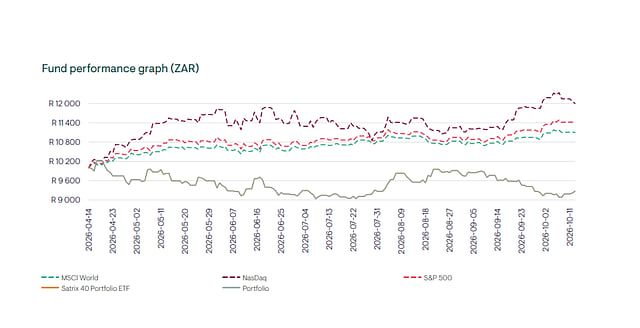
It is now six months later, and the tide has well and truly gone out, with the JSE’s fortunes turning around sharply compared to the rest of the world (See chart).
As Warren Buffett often said, “It’s when the tide goes out that one can see who is not wearing swimming trunks”.
In short, on the back of a sharp pullback in the price of gold and gold shares, aided by 45% decline in the price of Naspers, the JSE is now down about 13% from its peak while global markets have roared ahead by between 15 and 20%. A very big swing, probably one of the largest I have experienced in many a year.
Superficially, many commentators and local fund managers last year and earlier this were using the short run by the JSE as marketing material to drum up local business. A report on Bloomberg earlier this year also ascribed the good performance of the JSE during 2025 as “support for the GNU and the reform process underway”.
Well, if that was the case last year, the same support had headed out the door during the past six months.
I cannot count the many times I have listened to local fund managers trying to convince me the “JSE is a like a dripping roast”.
I disagreed and said so in public and private. Strip out gold shares and Naspers and there was very limited earnings growth coming from the other main drivers of the JSE Top20, with the exception of some banks.Six months later and one can now see the dramatic reversal of market fortunes of the JSE versus major global markets.
Gold shares have tumbled from their lofty valuations reached earlier this year while Naspers too, has experienced a very deep—and so far, a relentless decline in market capitalization.
Naspers is down 46% from its peak later last year and is now longer the largest shares on the JSE.
Goldfields now takes take top spot with another gold counter AngloGold Ashanti third in terms of market capitalization.
Admittedly, six months is not a long period of time, but without a sudden upsurge in the price of gold and hence gold shares, one can see the current trend reversing soon.
NASDAQ TAKING THE LEAD AGAIN
Over the six month period shares on the Nasdaq have once again taken the lead with a performance of +16% YTD, followed by the S&P500 up 13% as well as emerging markets.
The last six months have produced a striking reversal from the market panic at the end of March. The JSE has lagged badly, while US technology and emerging markets have rebounded strongly.
There are three important stories underneath these numbers.
- AI and US technology have reasserted themselves. Exceptionally strong corporate earnings and continued AI infrastructure investment have powered the global equity recovery. Reuters notes that AI-related capital expenditure has become an unusually powerful contributor to US economic growth, while US corporate earnings growth has remained very strong.
- Emerging markets have been exceptionally strong. MSCI Emerging Markets is up roughly 19% on the commonly quoted six-month measure and more than 21% YTD. This is important: the JSE’s weakness cannot simply be explained by investors avoiding emerging markets. Other emerging markets have substantially outperformed South Africa.
- The JSE has suffered from its particular composition and the Middle East/oil shock. At the end of March, the Resource 20 index had already been extremely volatile: resources fell 16.5% during March alone, while higher oil prices represented a particular threat to oil-importing South Africa
My central argument remains that the destruction of the SA economy, heaped on hapless citizens and investors over the past 15 years, does not allow one to form a positive long-term view of the private sector’s fortunes.
The late Dr Simon Marais, former chairman of Allan Gray, once said that the two prerequisites for a successful long-term investment in any country are rule of law and respect for property rights.
South Africa currently fails on both these grounds. Right now, SA is rightfully characterised as a failed state (in many parts), riven by crime and corruption (Madlanga/Zondo Commission), while the heroic private sector battles crime, collapsing infrastructure, and other legal/state obstacles unheard of in other countries.
ECONOMIC FORECASTS
Over the past 15 years, I have carefully tracked annual economic forecasts from our leading economists, mostly attached to asset management companies or banks. Their views on SA, the economy, exchange rates, and markets have an almost built-in positive slant.
Earlier this year, former chief economist at Old Mutual Johann Els (now with PSG) was quick out of the starting blocks with his scenario of 2-2,5% growth this year, with the rand possibly at R13,50 to the USD.
Chairman of Investec, Fani Titi, was also seeing the SA economy on “the runway to 3% growth ” in the near future.
Six months later, and with the latest horrific numbers of a 4% decline in manufacturing in September, we probably are already in a recession.
These, and other rose-tinted forecasts made at the beginning of the year, now seem silly, if not contrived.
I personally think our economists face career-ending consequences if they openly criticise the ANC or the country’s policy trajectory. Independent economists are few and far between, with perhaps Dawie Roodt and Rob Hersov mostly warning of our economic demise. Sakeliga’s Russel Lamberti is also not afraid to air his views.
Where is the late Mike Schussler, who wasn’t afraid to speak his economic mind in public?
LOCAL IS NOT LEKKER
If you slavishly followed the mainstream advice (local is lekker), you would have seen your personal fortunes grow very slowly, and in some cases dissipate in real terms.
Take the stock market, for instance.
R1m invested in the JSE Top 40 ten years ago is worth R3,1m today, roughly 9% per annum. Mmm, you might think, not too bad. But world stock markets have been in a roaring bull market over the same period — Covid and the War in Iran notwithstanding — with the same amount invested in the World Index (R4,1m), S&P500 (R5,01m) and the Nasdaq at R8,3m respectively today. Over a fifteen-year period, the differences are even bigger. In short: SA equity investors, via their portfolios, pension funds, and collective investments, have paid a substantial price by being under-exposed to world markets.
Residential property, too, tells a similar story.
I have long advised investors to sell their properties in Gauteng and reinvest the funds in the Western Cape, with the Paarl/Franschhoek/Stellenbosch area as my preferred choice.
The difference in returns has also been astounding.
The recent sale of Killarney Mall – an upmarket shopping centre in Killarney, Johannesburg – is a case in point of just how badly Gauteng properties have done over the past 15-20 years.
The mall has just been sold for R397m. I personally knew the mall’s previous owner, who sold it barely weeks before his untimely death in 2000 for R210m. A simple calculation shows the mall’s annual investment growth over the next 25 years was a mere 2,2% per annum.
I suspect most property owners in the greater Johannesburg area had similar returns, perhaps even less if one’s building has been hijacked or illegally occupied.
I live in Dainfern, a golfing estate north of Johannesburg. My own calculations show my property hasn’t grown much in NOMINAL terms over the past 10 years. That means I won’t get much more in rands than it was worth a decade ago.
Its a wonderful estate, with a golf course, clubhouse and a great community on the Jukskei River, but it’s when you leave the estate that you run into the non-working traffic lights, potholes, crumbling infrastructure and general neglect and decay.
Compare this to a property I purchased in the Val de Vie Estate for R2,7m 10 years ago. Excluding the rental income over the years, the property is now worth about R6,5-R7m.
These things matter to personal households over time. The really important point is that without a meaningful offshore asset exposure, either via equities or property, your global wealth had deteriorated substantially.
Any advice to globalize personal wealth is almost immediately slammed as negative, unpatriotic and based on scare-mongering.
I have many times being named all of the above, with the Financial Mail once describing me as Mr Doom in 2016 for my views for recommending offshore investments above local ones.
My recommendations obviously do not sit well with local asset managers—who make their fortunes managing local money—and have seen their funds shrink as a result of the massive outflow of capital, R1,3 trillion over the past 10 years, as I previously wrote on Biznews.
I have recently been joined by esteemed socio-political commentator Dr Frans Cronjé, who, on his Common Sense website, now openly advocates a Plan B approach to high-net-worth families, very much what I have been suggesting for some time.
But most HNWI’s have worked this out for themselves, long time ago.
*Magnus Heystek is founder of Brenthurst Wealth, SA’s largest independent financial advisory business.


 Megan joined the Brenthurst Wealth team in March 2026 as an Administrative and Fiduciary Services Assistant at our Val de Vie Office in the Western Cape. Prior to joining Brenthurst, Megan gained three years of experience in the retail sector, where she developed management and client service skills.


 I obtained my National Diploma in Financial Information Systems from the Cape Peninsula University of Technology in 1999 and have worked in the wealth management industry since January 2000. Over the years, I have gained extensive experience in various roles, including Portfolio Manager Assistant, Planner Assistant, and Paraplanner.
 Esmarelda Isaacs-Andreas joined the Brenthurst Wealth Stellenbosch office in October 2025, taking on the dual role of Receptionist and Fiduciary Administrator.
 I obtained my National Diploma in Financial Information Systems from the Cape Peninsula University of Technology in 1999 and have worked in the wealth management industry since January 2000. Over the years, I have gained extensive experience in various roles, including Portfolio Manager Assistant, Planner Assistant, and Paraplanner.

 Ashley joined Brenthurst Wealth in January 2025 as Office Administrative Assistant and Receptionist for the Stellenbosch Office.


 René Heystek joined Brenthurst Wealth in November 2023, as receptionist and administrative assistant in the newly established George/Garden Route office.

 Michelle Heystek has built a career in the financial services over the last two decades, after obtaining her B.Com degree in Financial Management in 2005. Once she joined Brenthurst in 2006, she continued her academic journey, obtaining her Certificate in Wealth Management from INSETA in 2007, followed by a Postgraduate Diploma in Financial Planning from the University of the Free State. In 2008, she earned the Certified Financial Planner (CFP®) designation.


 Anelle joined Brenthurst Wealth as a Receptionist and Administrative Assistant to Brian Butchart in the Cape Town office in December 2023. She has a wealth of knowledge from working as a liaison between Financial Advisers and clients at TMA and Absa Investment Management Services (Aims) since 1998. She obtained her B. com degree from the University of Port Elizabeth in 1997.


 ADMITTED ATTORNEY | FINANCIAL PLANNER & HEAD OF BRENTHURST FOURWAYS


 Sanet was appointed in April 2020, joining our Cape Town team as an Executive Administration Assistant to Renee Eagar. She has been in the financial services industry since 1990. Her previous experience includes positions at Sanlam, BJM and ABSA. She spent her last 12 years working at Alexander Forbes Private Client Wealth as a Senior Wealth Management Assistant. She has received numerous accolades over the years which include but not limited to, Alexander Forbes Client Service Excellence – Silver award in 2014,2015 and 2017. Sanet has also obtained her Certificate in Wealth Management (NQF 5) in 2012 and achieved “Best Student of the Year” from Moonstone.


 Maria Smit is a Certified Financial Planner® with over 10 years of experience in the financial planning industry.