
Of the 15 top-performing funds over the past 10 years, 10 are global equity funds.
By Ruan Breed – Brenthurst Wealth
The ‘bullish vs bearish debate’ is one that is as old as time, as is the local vs offshore conversation. At any given point in time, you will find punters on either side of the equation – bulls vs bears, and local vs offshore. It is for this reason that, depending on whom you turn to for investment advice, you will find different responses, varying portfolio constructions and asset allocations that depict different market sentiments.
It is not any new news that if an investor looks to beat inflation and grow capital over the long term, their portfolio should predominantly be exposed to equities as an asset class. Even more important than getting exposure to equities, is where you get this exposure. Local, or offshore?
Hindsight is always perfect, and you can be forgiven if you batted for Team Bears over the last 12-18 months, given that markets were down on average by almost 25%. However, markets are ever-changing and forward-looking, and this doom and gloom picture quickly changed. You might find a few ‘2022 bears’ sitting on the fence right now given the start to the year 2023 that markets experienced globally. Since October, the S&P 500 recovered by almost 16%, and YTD (year-to-date) the index is up by more than 8%.
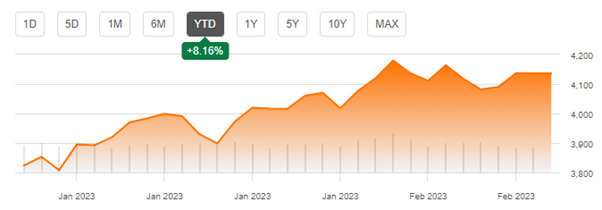
Yet, this will not be enough to put the ‘bullish vs bearish’ discussion to bed. And to be quite frank, even should markets double these returns over the next quarter or year or whatever period you look at, you will still find punters on both ends. Some individuals are more risk-averse than others.
At the end of it all, it does not really matter whether you hold a bullish or bearish view over the markets, or whether you guess what the Fed’s next move might be. Why? Because it will have zero effect on where markets will go, and as a matter of fact, you might be 100% wrong, 100% of the time.
Investors and market pundits across the board warned that 2023 might make 2022 look like a walk in the park. Red lights flashed all over the screens, US inflation was still high, tech companies are laying off employees quicker than SA appoints ministers, earnings targets are missed by some of the biggest companies in the US, and the list goes on. Yet here we are. Markets on both local and global fronts have recovered extremely well. And although we might not be out of the woods yet, it just goes to show that markets do not care what you, or in fact, anyone of us thinks.
As mentioned, I recently read an article that indicated that of the 15 top-performing funds over the past 10 years, 10 are global equity funds, four are South African resource funds, and only one is a local equity portfolio. The four resource funds have been the only local funds to deliver returns close to par with the global equity funds. Remember, these numbers are even after we experienced a major tailwind during Covid in our local resource sector and went through a big market correction on global fronts, especially in the US. Still, global equities came out on top.
*Just to mention – if it wasn’t for load shedding and railway issues brought on by SA’s incapable government, this picture would have looked different. Coal mines specifically miss out on eye-watering exports due to a lack of various infrastructures. This was especially the case in Covid when resource prices soared to record highs and SA was unable to get all their mining material to the harbours due to a lack of railway infrastructure.
Nevertheless, it is evident that to have grown your ZAR portfolio over the last decade, you needed offshore equity exposure, otherwise, you would have got left behind. There are two reasons for this:
- Offshore assets as an investment performed better, and
- The exchange rate would have slaughtered your portfolio should you not have been hedged.
The average annualized return for SA Equity Resources was roughly 13% over the last 10 years. For the Global Equity class, this number was 13.50%. By stark contrast, the number for local equities is 8%.
Several factors lead to the outperformance of global equities compared to local stocks. Yes, loose monetary policies especially the US were one of them, but there is more to it than just that. On local fronts, we are faced with structural economic issues, not limited to:
- Loadshedding;
- Unemployment of roughly 35%;
- Red tape putting the brakes on private companies;
- Socialist state: 29 million people receive grants, whilst only 7.4 million pay taxes; and
- Lack of infrastructure and service delivery from the state.
Furthermore, if it wasn’t for the fact that SA exported most of its locally mined resources, this sector would have also swallowed investors.
Here is a closer look at what the rand/dollar did over the last decade:
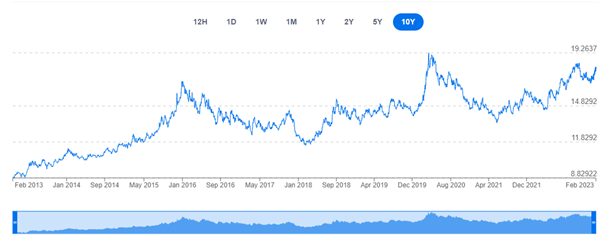
Your rands have lost value by more than 103% in 10 years. In February 2013, you would have paid R8.80 for a dollar, and today, more than R18. Therefore, if your capital was invested mostly in South African equity funds, you would have fallen extremely far behind, and became extremely poor in global terms.
This is, however, avoidable by allocating your long-term capital to the right funds and global equities. Below is a table indicating the monetary returns you would have achieved by investing R10 000 into these global equity funds 10 years ago:
| 10-Year Annualised Return | Terminal Value – 10 years | |
| Fundsmith Equity Fund | 21% | R67 275.00 |
| Ranmore Global Equity Fund | 16.50% | R46 053.14 |
| Ninety One Global Franchise Fund | 17.25% | R49 105.32 |
| Franklin US Opportunities Fund | 19.51% | R59 435.03 |
| Fidelity Global Healthcare Fund | 18.43% | R54 277.18 |
The portfolio protected and grew capital by above-inflation returns and kept the capital in line with currency depreciation. Therefore, the risk was, in fact, to not take on any risk and remain in either cash or predominantly local funds.
Even in dollar terms, these funds outperformed most of the local funds over 10 years.
| 10-Year Annualised Return | Terminal Value – 10 years | |
| Fundsmith Equity Fund | 13% | R33 408.81 |
| Ranmore Global Equity Fund | 8.54% | R22 693.33 |
| Ninety One Global Franchise Fund | 9.14% | R23 979.47 |
| Franklin US Opportunities Fund | 11.25% | R29 040.24 |
| Fidelity Global Healthcare Fund | 10.24% | R26 508.92 |
Not a single fund took an overweight stance to a certain sector or industry such as tech, biotech etc., except for the Fidelity Healthcare Fund, which is a sector-specific fund. These funds invest in companies on a global scale across all sectors and industries.
If you were a South African investor, the only local funds that would have protected and grown your wealth would have to be exposed to the resource sector predominantly, which in itself is a very high-risk approach to take as these companies are extremely volatile for various reasons. Global equity funds are where the money was made, and whether this will transpire in the coming 10 years, remains to be seen.
Discuss your approach to investment selection with an experienced, qualified advisor to make the best decision suited to your circumstances and risk profile.


 Megan joined the Brenthurst Wealth team in March 2026 as an Administrative and Fiduciary Services Assistant at our Val de Vie Office in the Western Cape. Prior to joining Brenthurst, Megan gained three years of experience in the retail sector, where she developed management and client service skills.


 I obtained my National Diploma in Financial Information Systems from the Cape Peninsula University of Technology in 1999 and have worked in the wealth management industry since January 2000. Over the years, I have gained extensive experience in various roles, including Portfolio Manager Assistant, Planner Assistant, and Paraplanner.
 Esmarelda Isaacs-Andreas joined the Brenthurst Wealth Stellenbosch office in October 2025, taking on the dual role of Receptionist and Fiduciary Administrator.
 I obtained my National Diploma in Financial Information Systems from the Cape Peninsula University of Technology in 1999 and have worked in the wealth management industry since January 2000. Over the years, I have gained extensive experience in various roles, including Portfolio Manager Assistant, Planner Assistant, and Paraplanner.
 Ashley joined Brenthurst Wealth in January 2025 as Office Administrative Assistant and Receptionist for the Stellenbosch Office.


 René Heystek joined Brenthurst Wealth in November 2023, as receptionist and administrative assistant in the newly established George/Garden Route office.
 Michelle Heystek has built a career in the financial services over the last two decades, after obtaining her B.Com degree in Financial Management in 2005. Once she joined Brenthurst in 2006, she continued her academic journey, obtaining her Certificate in Wealth Management from INSETA in 2007, followed by a Postgraduate Diploma in Financial Planning from the University of the Free State. In 2008, she earned the Certified Financial Planner (CFP®) designation.


 Anelle joined Brenthurst Wealth as a Receptionist and Administrative Assistant to Brian Butchart in the Cape Town office in December 2023. She has a wealth of knowledge from working as a liaison between Financial Advisers and clients at TMA and Absa Investment Management Services (Aims) since 1998. She obtained her B. com degree from the University of Port Elizabeth in 1997.


 ADMITTED ATTORNEY | FINANCIAL PLANNER & HEAD OF BRENTHURST FOURWAYS

 Sanet was appointed in April 2020, joining our Cape Town team as an Executive Administration Assistant to Renee Eagar. She has been in the financial services industry since 1990. Her previous experience includes positions at Sanlam, BJM and ABSA. She spent her last 12 years working at Alexander Forbes Private Client Wealth as a Senior Wealth Management Assistant. She has received numerous accolades over the years which include but not limited to, Alexander Forbes Client Service Excellence – Silver award in 2014,2015 and 2017. Sanet has also obtained her Certificate in Wealth Management (NQF 5) in 2012 and achieved “Best Student of the Year” from Moonstone.


 Maria Smit is a Certified Financial Planner® with over 10 years of experience in the financial planning industry.


