A married couple who donate R300 000 a year to their children for 20 years move approximately R6 million out of their estate (without interim growth accounted for), but at 10% annual compound growth that money is worth about R18.9 million by year 20.
Had it stayed in their estate, the South African Revenue Service (Sars) would have collected roughly R6.5 million in estate duty and capital gains tax (CGT) on death. This makes the case for transferring surplus capital (legally) out of your dutiable estate, to your eventual beneficiaries, to invest in a further tax-efficient vehicle.
Few families use the simplest tool the law offers, which is the annual donations tax exemption. Almost all estate structuring conversations start with: life cover, trusts, wills, etc., but this strategy costs nothing to set up, needs no trust deed, and works best for exactly the families who think they don’t need it. Those whose retirement is already well funded and whose dutiable estate keeps growing even further.
Read: Effective strategies for intergenerational wealth management
This article walks through how the strategy works, puts numbers on a practical 20-year example, and ends with a practical guide for parents who want to execute it for themselves and their children.
How does it work, and what are the rules?
When a South African taxpayer passes away, there are three various taxes and costs applicable to its dutiable estate/assets:
- Estate duty
- Capital gains tax (death is a CGT event as it is seen as a deemed disposal of assets)
- Executor’s fees
These taxes and costs may lead to a situation where the beneficiaries of parents may inherit substantially less than they planned for. As a ballpark figure, these collected taxes and costs could reduce the estate by about 25-35%, all things considered.
How can this be addressed by one of the simplest tools available, but is almost never used?
Every South African resident individual may donate up to R150 000 per tax year free of donations tax. A married couple can therefore give R300 000 a year between them: R150 000 to each of two children. Above the exemption, donations tax is 20% (25% on cumulative donations above R30 million), so staying within the limit is important to not pay any tax.
There are four other rules that turn this exemption into a powerful planning tool:
| Rule | Outcome for the family |
| Estate duty | 20% on the dutiable estate up to R30 million and 25% above that, after the R3.5 million abatement per person (portable to the surviving spouse). Assets left to a spouse are deductible, so the big problem usually arise on the second death. |
| CGT on death | On death, assets are deemed to be sold at market value (s9HA). Growth is taxed at an effective rate of up to 18% (40% inclusion at a 45% marginal rate). |
| Tax-free savings account (TFSA) | Each child can receive R46 000 a year into a TFSA, up to R500 000 over their lifetime. Interest, dividends and capital gains inside it are never taxed. Here, the investment horizon is very important, and younger investors have the biggest benefit. |
| Growth goes with the gift | Once donated, the asset and all its future growth belong to the child. The parents’ estate stops growing on that money from the day it leaves. |
The last point is the one most families underestimate. The exemption caps what you give each year, but it does not cap to what value those donations can grow to in the hands of the receiver(s)/children.
Read: The taxman’s gift – and the hidden catch that could cost your family millions
The practical 20-year example
Meet a hypothetical couple in their mid 40s. Both are still earning, their retirement savings are on track, and they hold a sizeable discretionary portfolio. They have two young children and decide to donate the full exemption every year, for 20 years.
| Assumption | Values |
| Donation | R150 000 per parent per year (R300 000 in total), made at the start of each tax year for 20 years. |
| Per child | R150 000 a year. (The principle remains the same regardless of the number of children in the family) |
| TFSA | R46 000 a year per child until the R500 000 lifetime limit is reached in year 11 (R40 000 in that year) |
| Discretionary portfolio | The rest of the funds: R104 000 a year in years 1–10, R110 000 in year 11, R150 000 in years 12–20 |
| Growth | 10% a year after fees, on the children’s investments and on what the parents would otherwise have kept in their own estate. |
| Inflation | 6% a year, used to show values in today’s money (Real value) |
| Estate duty | 25% (the estate is assumed to exceed R30 million by the second death) |
| CGT on death | 18% of the growth (max marginal rate) |
In one example the parents keep the R300 000 a year in their own estate/portfolio. In the other they donate it. Everything else remains constant.
Saving 1: a smaller estate, with less tax
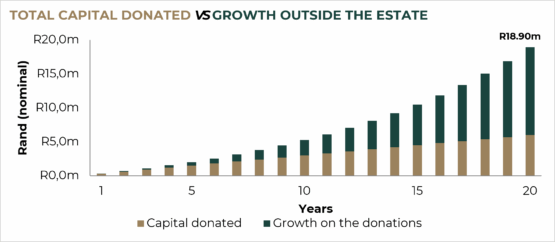
Illustrative projection · R300 000 donated at the start of each year, at 10% growth
By year 20 the parents have given away R6 million, yet R18.9 million sits outside their estate when accounting for the compound growth and the value it would have been inside their own estate.
More than two-thirds of that is growth that is not on their balance sheet any longer, so it can never be taxed in their hands as it would have been.
Here is what happens to the money at year 20 if the second parent dies:
| At year 20 | Parents keep it | Parents donate it |
| Value | R18 900 750 | R18 900 750 |
| CGT on death (18% of R12.9m growth) | (R2 322 135) | Nil |
| Estate duty (25% of value after CGT) | (R4 144 654) | Nil |
| Funds inherited by the children | R12 433 961 (66%) | R18 900 750 (100%) |
That is a difference of R6.47 million more for the children, or about R2 million in today’s money.
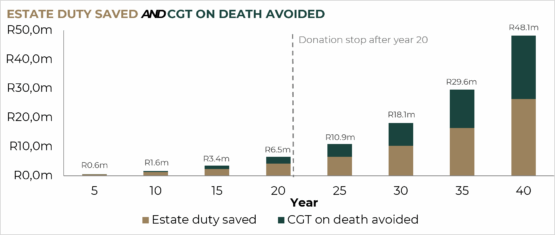
Illustrative projection: estate duty 25% of value after CGT and CGT 18% of growth
The savings do not stop when the donations stop. Every year the parents live after the last donation, the money keeps compounding outside their estate, in the hands of their children. If the second death is in year 30, the tax avoided increases to about R18.1 million (R3.1 million in today’s money).
Another saving is not counted for in this example: executor’s fees of up to 3.5% plus Vat are charged on gross assets in a dutiable estate.
On R18.9 million that is a further R760 000 approximately, which is basically legal fees to dissolve the estate.
Read: The family you have, the financial plan you need
Another non-financial aspect (but no less important) to keep in mind, is that the inheritance of discretionary assets can be subject to substantial delays, meaning the eventual beneficiaries can wait several months or even years for the funds to get to them, whereas in the strategy explained in my article, the funds are already in the hands of the children.
Any surplus funds inherited by the children can then go through the estate administration process without causing any issues for the children, as they already have funds to at least live off, if necessary.
Saving 2: what the children build
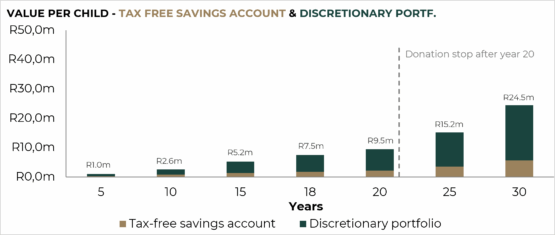
Illustrative projection · R46 000 a year into the tax-free savings account (TFSA) until the R500 000 lifetime limit, the surplus into a discretionary portfolio where normal taxes apply also at 10% growth
Each child’s R3 million of donations grows to R9.45 million by year 20. The TFSA is maxed out after 11 years, having taken the child’s entire R500 000 lifetime allowance, and by year 30 that R500 000 is worth R5.7 million. Every rand of that growth is free of income tax, dividends tax and CGT, for the rest of the children’s lives.
Read: Top 10 financial priorities for single mothers
The discretionary portfolio is not tax-free, but it is taxed in the child’s hands, not the parents. The child’s tax rate is usually far lower, and the child has a longer investment horizon, giving them the compound growth benefit:
- Each child has their own R40 000 annual CGT exclusion. Realising R40 000 of gains a year and reinvesting resets the base cost at no tax cost.
- A student with little other income pays very little. For example, a R300 000 gain realised at age 20 leaves R104 000 of taxable gain after the exclusion and 40% inclusion, and the tax on that is about R1 500 after the primary rebate (2025/26 tables).
- Nothing is payable until the child actually sells, so the liability can be deferred for decades.
Compare that with the parents, who would pay 45% income tax on interest and foreign dividends and 18% CGT on the same portfolio for as long as they owned it.
This, however, is secondary to the actual benefit in terms of estate duty in the case where the parents pass away with more funds in their estate than they require for a comfortable retirement.
What it could be worth at various points in future:
If the strategy starts in the year a child is born, each child turns 18 with about R7.5 million, or R2.6 million in today’s money. The donations continue until age 20 and the money keeps compounding after that.
| Child’s age | Value per child | In today’s money | Of which in the TFSA |
| 18 | R7 523 864 | R2 635 939 | R1 814 406 |
| 25 | R15 219 923 | R3 546 221 | R3 535 764 |
| 30 | R24 511 839 | R4 267 759 | R5 694 383 |
| 35 | R39 476 561 | R5 136 107 | R9 170 860 |
The TFSA alone grows to R9.2 million by 35 from just R500 000 of contributions made before the child turned 11. That is what a long time horizon does: the child’s age is the most valuable asset in this plan, as I have pointed out previously.
Families who start later still benefit, just less. A child who is 10 when the plan begins has eight years of growth by 18 instead of 18, so the earlier the first donation, the bigger the result.
The benefits, however, still remain for any family where the parents have enough assets for a comfortable retirement, where children will be the eventual beneficiaries.
Read: Why having a will is the first step – but not enough
Traps to look out for
The strategy is simple, but a few rules can undo part of the benefit if ignored.
- Income attribution while children are minors. Under section 7(3) of the Income Tax Act, income earned on money a parent donates to a minor child is taxed in the parent’s hands. Paragraph 69 of the Eighth Schedule does the same for capital gains. This does not affect the TFSA, where the income is exempt anyway, nor the estate duty saving. It does mean that, until 18, the discretionary portfolio should favour growth over interest and foreign income.
- The exemption is only per tax year. The R150 000 resets on 1 March each year and unused amounts do not carry forward. Missing a year is a permanent loss of that year’s saving/donation.
- Do not exceed the limits. Donations above R150 000 per donor attract 20% donations tax. TFSA contributions above R46 000 a year or R500 000 in a lifetime attract a 40% penalty on the excess.
- At 18 the money belongs to the child. Majority in South Africa is 18. From then the child has full legal control of their TFSA and portfolio, and the parents can’t stop them withdrawing it. It is therefore important to coach and learn your children about investments and compound growth.
- Keep enough for yourselves. The plan works only if the parents’ own retirement is secure without the donated money. Fund donations from discretionary investments, never from retirement funds.
- Your estate still needs cash. A smaller estate means less duty, but executors still need liquidity for the duty, CGT and costs that will be applicable.
Read: Are you making these three costly TFSA mistakes?
A practical guide for parents
- Check affordability first. Ask your wealth manager to model your retirement with and without the donations, including a stress-test scenario. If your projected withdrawal rate stays comfortably below about 4%, the donations are affordable.
- Open the accounts in the child’s name. Open a TFSA and a discretionary unit trust or share portfolio for each child, with you as guardian and signatory while they are minors. Pay the money directly from each parent’s account.
- Fill the TFSA first. Put R46 000 into the TFSA every year until the R500 000 lifetime limit is reached, then direct the full donation to the discretionary portfolio.
- Invest for growth. With a 20-year-plus horizon, a diversified equity-exposed portfolio is usually appropriate.
- Keep a paper trail. Record each donation.
- Use the child’s own CGT exclusion. Once a child turns 18, realise up to R40 000 of gains in the discretionary portfolio each year and reinvest, so their base cost keeps pace with growth.
- Prepare the child for 18. Start money conversations early. By the time control passes, the child should understand what the money is for, how it is invested and why it should be left to grow. Show the results of the compound growth of the child’s own portfolio.
- Update your wills. State whether lifetime donations must be taken into account when your estate is divided, so that children who receive different amounts are treated as you intend.
- Review every year. Check the current exemption and TFSA limits after each February Budget, and review returns, spending and the plan’s fit with the rest of your estate plan.
Read: Succession strategies for preserving generational wealth
For a family whose retirement is already secure, R300 000 a year is a modest donation. Over 20 years it can move R18.9 million out of the parents’ estate, save R6.5 million in death taxes (more the longer the parents live), and give each child a seven- or eight-figure head start with a tax-free core that grows for life.
It also assists in helping the children whilst the parents are still alive, and the children are in a phase of life where they can actually use the funds, instead of a scenario where the children inherit the funds when they are 50-60 themselves, and do not necessarily need the funds and where these funds are then taxed more aggressively in both the parents estates and in the children’s hands.
It is not a complete estate plan. Families with a business, farm or property portfolio, or who want more control over when children gain access, should discuss how a trust, a will and life cover fit alongside annual donations.
Donating to a trust also uses the exemption, but trusts bring their own tax costs and rules. Annual donations are simply the easiest first step, and the one that rewards an early start most. This is the easiest, most valuable strategy to follow first.
These are illustrative projections based on the assumptions stated, not guarantees. Returns, inflation and tax law will differ. The figures used for the donations tax exemption (R150 000) and TFSA limit (R46 000) should be confirmed against current Sars rules. This article is general information and does not constitute personal financial, tax or legal advice. Speak to a qualified wealth manager.


 Megan joined the Brenthurst Wealth team in March 2026 as an Administrative and Fiduciary Services Assistant at our Val de Vie Office in the Western Cape. Prior to joining Brenthurst, Megan gained three years of experience in the retail sector, where she developed management and client service skills.


 I obtained my National Diploma in Financial Information Systems from the Cape Peninsula University of Technology in 1999 and have worked in the wealth management industry since January 2000. Over the years, I have gained extensive experience in various roles, including Portfolio Manager Assistant, Planner Assistant, and Paraplanner.
 Esmarelda Isaacs-Andreas joined the Brenthurst Wealth Stellenbosch office in October 2025, taking on the dual role of Receptionist and Fiduciary Administrator.
 I obtained my National Diploma in Financial Information Systems from the Cape Peninsula University of Technology in 1999 and have worked in the wealth management industry since January 2000. Over the years, I have gained extensive experience in various roles, including Portfolio Manager Assistant, Planner Assistant, and Paraplanner.

 Ashley joined Brenthurst Wealth in January 2025 as Office Administrative Assistant and Receptionist for the Stellenbosch Office.



 René Heystek joined Brenthurst Wealth in November 2023, as receptionist and administrative assistant in the newly established George/Garden Route office.

 Michelle Heystek has built a career in the financial services over the last two decades, after obtaining her B.Com degree in Financial Management in 2005. Once she joined Brenthurst in 2006, she continued her academic journey, obtaining her Certificate in Wealth Management from INSETA in 2007, followed by a Postgraduate Diploma in Financial Planning from the University of the Free State. In 2008, she earned the Certified Financial Planner (CFP®) designation.


 Anelle joined Brenthurst Wealth as a Receptionist and Administrative Assistant to Brian Butchart in the Cape Town office in December 2023. She has a wealth of knowledge from working as a liaison between Financial Advisers and clients at TMA and Absa Investment Management Services (Aims) since 1998. She obtained her B. com degree from the University of Port Elizabeth in 1997.


 ADMITTED ATTORNEY | FINANCIAL PLANNER & HEAD OF BRENTHURST FOURWAYS


 Sanet was appointed in April 2020, joining our Cape Town team as an Executive Administration Assistant to Renee Eagar. She has been in the financial services industry since 1990. Her previous experience includes positions at Sanlam, BJM and ABSA. She spent her last 12 years working at Alexander Forbes Private Client Wealth as a Senior Wealth Management Assistant. She has received numerous accolades over the years which include but not limited to, Alexander Forbes Client Service Excellence – Silver award in 2014,2015 and 2017. Sanet has also obtained her Certificate in Wealth Management (NQF 5) in 2012 and achieved “Best Student of the Year” from Moonstone.


 Maria Smit is a Certified Financial Planner® with over 10 years of experience in the financial planning industry.