
Many South African investors are starting to realise that having a healthy offshore allocation to their portfolio has been handsomely rewarding, especially over the last 10 years.
Investing offshore requires investors to take a long-term view such as seven to 10 years, and for this example, we will look at investing in a USD portfolio. Here are some reasons why you need to take a long-term view:
- Although US interest rates have increased over the last year to 5%, one cannot invest offshore in interest-generating asset classes such as cash investments, as this asset class will not give you a chance of beating inflation or generating long-term wealth.
- Therefore, equities would be the preferred asset class for an offshore portfolio. Equities, by nature, are volatile which means that you will need to remain invested for long periods to ‘ride out’ market volatility.
- The stock market has tended to recover from downturns and corrections over time. While it can be tempting to sell off your investments during market downturns, staying invested and riding out the volatility can often lead to higher returns in the long run.
- Long-term investing can help you benefit from the power of compounding. By reinvesting dividends and capital gains back into your investments, you can potentially earn returns on your returns, leading to exponential growth over time.
Here are some reasons why you should invest offshore:
- A diversification strategy to grow your wealth over the long term.
- To gain exposure to international markets and investment opportunities that are not available in South Africa.
- By investing offshore, you generally can achieve better risk/return characteristics through this diversification strategy.
- To find value in first-world markets for long-term growth and potentially, superior returns
- To hedge against a depreciating rand. The ZAR has depreciated against the USD by over 50% in the last five years alone. Many analysts and economists predict further depreciation over the long term going forward.
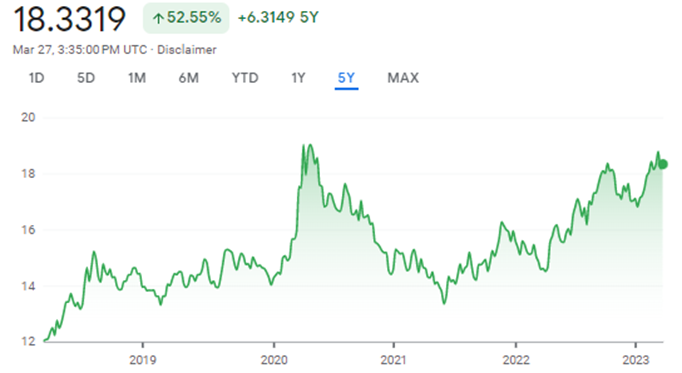
Source: Google Finance
The question often posed is, do you take money offshore even when the rand is weak?
This all depends on the investor’s willingness to pay the price of the foreign currency at the time they are wanting to invest. The risk, however, is that if you wait, the rand may weaken even further, and you will not be invested in the market. The sooner you get into the market the better. Although the exchange rate is an important factor when taking money offshore, the focus of investing offshore is to grow your wealth in USD terms.
A recent study conducted by Ninety One illustrates that the average annualised return was similar when investors initially invested in times of the rand being strong, and the rand being weak.
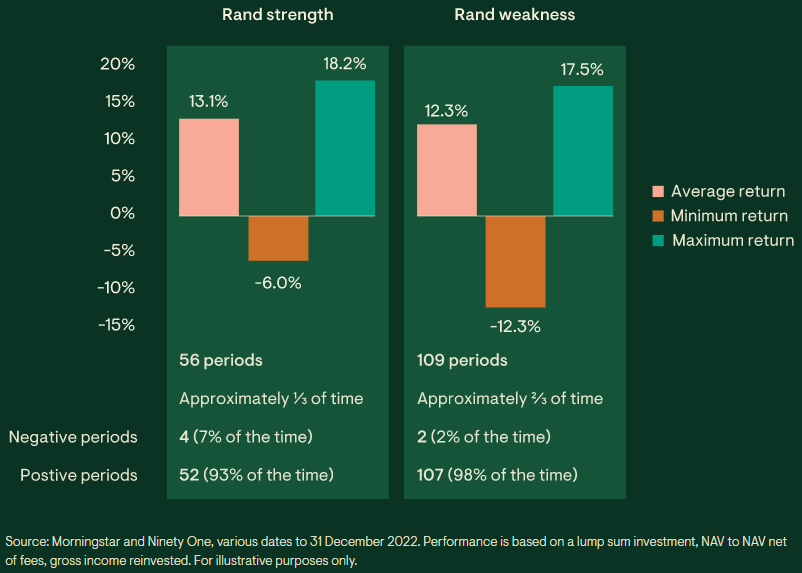
Long-term investors generally focus on the bigger picture and tend to be comfortable with market and exchange rate volatility.
When deciding to invest offshore, you can either invest directly in shares, unit trusts, or in a wrapper structure such as endowments and sinking funds. Wrapper structures impose a five-year restriction period, but this should not deter you from investing in these structures since offshore investing requires you to take a long-term view.
Here is a summary of the endowment and sinking fund structure:
| Consider making use of offshore endowments and/or sinking fund structures | |
| Probate | There is no probate applicable to the investment when beneficiaries are nominated. This should not cause delays for the local estate to be administered. |
| Taxation | Income tax is applied at 30% and capital gains tax at 12% |
| Situs tax | Capital and/or direct share portfolios that are held within a wrapper-type investment are not subject to Situs (death tax) in the US or UK. |
| Investment continuity | Beneficiaries can be nominated, which creates continuity and generational wealth. |
| Protection against creditors | Endowment: Yes (subject to certain conditions) Sinking fund: No |
| Liquidity on death | Endowment: The beneficiary must continue with the five-year term in the event they receive the benefit during the restricted five-year period. |
| Sinking funds: The proceeds of the investment become fully liquid upon the death of the contract owner | |
| Executor’s fees | Provided that beneficiaries are nominated, the investment does not attract any executor’s fees because it is handled outside the estate. |
Diversification is one of the most important ways to balance risk and return in an investment portfolio. How much offshore allocation to have will purely depend on the investor’s unique circumstances and risk profile.
All investment decisions are best decided with the guidance of a trusted wealth advisor.


 Megan joined the Brenthurst Wealth team in March 2026 as an Administrative and Fiduciary Services Assistant at our Val de Vie Office in the Western Cape. Prior to joining Brenthurst, Megan gained three years of experience in the retail sector, where she developed management and client service skills.


 I obtained my National Diploma in Financial Information Systems from the Cape Peninsula University of Technology in 1999 and have worked in the wealth management industry since January 2000. Over the years, I have gained extensive experience in various roles, including Portfolio Manager Assistant, Planner Assistant, and Paraplanner.
 Esmarelda Isaacs-Andreas joined the Brenthurst Wealth Stellenbosch office in October 2025, taking on the dual role of Receptionist and Fiduciary Administrator.
 I obtained my National Diploma in Financial Information Systems from the Cape Peninsula University of Technology in 1999 and have worked in the wealth management industry since January 2000. Over the years, I have gained extensive experience in various roles, including Portfolio Manager Assistant, Planner Assistant, and Paraplanner.
 Ashley joined Brenthurst Wealth in January 2025 as Office Administrative Assistant and Receptionist for the Stellenbosch Office.


 René Heystek joined Brenthurst Wealth in November 2023, as receptionist and administrative assistant in the newly established George/Garden Route office.
 Michelle Heystek has built a career in the financial services over the last two decades, after obtaining her B.Com degree in Financial Management in 2005. Once she joined Brenthurst in 2006, she continued her academic journey, obtaining her Certificate in Wealth Management from INSETA in 2007, followed by a Postgraduate Diploma in Financial Planning from the University of the Free State. In 2008, she earned the Certified Financial Planner (CFP®) designation.


 Anelle joined Brenthurst Wealth as a Receptionist and Administrative Assistant to Brian Butchart in the Cape Town office in December 2023. She has a wealth of knowledge from working as a liaison between Financial Advisers and clients at TMA and Absa Investment Management Services (Aims) since 1998. She obtained her B. com degree from the University of Port Elizabeth in 1997.


 ADMITTED ATTORNEY | FINANCIAL PLANNER & HEAD OF BRENTHURST FOURWAYS

 Sanet was appointed in April 2020, joining our Cape Town team as an Executive Administration Assistant to Renee Eagar. She has been in the financial services industry since 1990. Her previous experience includes positions at Sanlam, BJM and ABSA. She spent her last 12 years working at Alexander Forbes Private Client Wealth as a Senior Wealth Management Assistant. She has received numerous accolades over the years which include but not limited to, Alexander Forbes Client Service Excellence – Silver award in 2014,2015 and 2017. Sanet has also obtained her Certificate in Wealth Management (NQF 5) in 2012 and achieved “Best Student of the Year” from Moonstone.


 Maria Smit is a Certified Financial Planner® with over 10 years of experience in the financial planning industry.


