A few months ago, I sat down with a client, I will call Annelie. She is 59, recently retired, and holds a portfolio of US-listed shares and ETFs worth around $600 000. The portfolio was not built through her own annual offshore allowances.
It came to her as an inheritance from an uncle who had lived in the UK for most of his adult life and passed away there. She simply kept the account running as she received it, added nothing, withdrawn nothing, and assumed that because the money ‘came from overseas’, her estate planning was already taken care of.
She was half right. But the half she had wrong could have cost her heirs close to a third of the portfolio.
Read: The invisible expense: Why tax should be the first line item in your budget
The half she had right: A valuable exemption at home
South African residents are taxed on their worldwide assets when they die. Estate duty is levied at 20% on the dutiable estate up to R30 million and 25% above that, so a $600 000 portfolio would ordinarily sit in that space.
However, the SA Estate Duty Act contains a carve-out for exactly Annelie’s situation. Where a South African resident holds an asset situated outside the country, and that asset was acquired by way of an inheritance or donation from a person who was not ordinarily resident in South Africa at the time, the asset falls outside the dutiable estate altogether.
Parliament’s logic was sound, wealth that was created abroad, taxed abroad, and transferred by a foreigner should not be swept into the South African net merely because the recipient happens to live here.
So, on her death, the South African Revenue Service (Sars) would levy no estate duty on this portfolio at all. Annelie knew this, at least in broad terms, and it is what led to her believing her house was in order.
Read: Offshore at retirement: The tax-residency mistakes wealthy South Africans can’t afford
The half she had wrong: The country of the asset gets its share
What the exemption at home does not do is protect the asset from death taxes in the jurisdiction where it is located. Most developed markets impose some form of inheritance or estate tax on assets physically or legally situated within their borders, regardless of where the owner lives.
This is commonly referred to as situs tax, and the United States is the most aggressive example.
A South African who dies holding US registered shares directly is treated as a non-resident alien for US estate tax purposes.
The exemption available to South Africans is not the generous threshold American citizens enjoy; it is a mere $60 000.
Everything above that is taxed on a sliding scale that climbs to 40%. On Annelie’s $600 000 portfolio, the exposure works out to roughly $180 000, around 30% of the portfolio and because the tax scale is progressive, the effective rate creeps closer to 40% as the portfolio grows.
If she lives another twenty years and the portfolio compounds to $2 million or more, the amount at risk becomes genuinely frightening.
Read: How to protect your offshore investments from offshore taxes and estate problems
It gets worse before it gets better. Before her heirs could take transfer of the shares, her executor would need to obtain a grant of probate in the US, and that grant is generally only issued once the estate tax has been settled.
The estate must therefore find the cash to pay the tax before it can access the very asset intended to fund it.
Add South African executor’s remuneration of up to 3.5% plus Vat, foreign legal fees, and capital gains tax triggered by the deemed disposal on death, and it is entirely realistic for half of the portfolio’s value to leak away between her death and the money landing in her children’s hands.
In other words: the asset that is fully exempt from estate duty in South Africa was on track to be the most heavily taxed asset in her entire estate.
The toll gate: Paying CGT now to escape a bigger tax later
Fixing the problem means changing the structure through which the shares are held, and changing the structure means selling.
A sale triggers capital gains tax in South Africa at an effective rate of up to 18% for an individual and in Annelie’s case the gain was meaningful, because her base cost was set at the market value on the date she inherited and the portfolio had grown well since.
So, this big capital gain can push her up to the 18% effective capital gains tax (CGT) rate even if her marginal income might be low.
CGT will be payable on this portfolio eventually in any event, whether on death or on eventual sale by her heirs. Paying it now resets the base cost, and in exchange she removes a foreign estate tax exposure running at 30% to 40% of the entire capital value, not merely of the growth.
Paying 18 cents on the rand of gain to eliminate a potential 40 cents on the rand of capital is one of the easier trades in portfolio structuring. The real question is what structure to move into once the shares are sold.
Read: Navigating offshore investments: Understanding your direct and indirect options
The optionality of structures
Broadly, a South African investor in this position has three categories of vehicle available, all accessible through the mainstream offshore investment platforms operating in our market.
Each solves a different part of the problem, and none of them solves everything, so in all probability, the perfect solution will be structured as a combination.
The first option is an offshore investment account administered through a South African nominee structure, holding collective investment funds rather than direct shares. Because the underlying unit trusts are not US situs assets, the American estate tax problem disappears immediately. The difficulty is what replaces it.
The nominee entity sits in South Africa, which makes the investment a South African situs asset, and that drags it straight back into the local dutiable estate, forfeiting the very exemption that made Annelie’s position attractive in the first place.
Succession runs through her South African will, which is administratively effective, but executor’s fees apply and estate duty of 20% or more would now be payable where previously none was due.
For an investor without her inheritance history this structure is perfectly sensible but for her, it would amount to swapping a foreign tax problem for a local one.
Read: The Holy Grail of direct offshore investment
The second option is the same type of flexible investment account but administered through a nominee entity domiciled offshore. Now the asset is situated neither in the US (no situs tax because the funds held are not US registered) nor in South Africa (the foreign nominee keeps it outside the local net, and the inheritance carve-out continues to apply).
Succession can still be dealt with under her South African will, and the account remains fully accessible during her lifetime. She can draw on it, switch funds, or unwind it whenever she chooses.
The residual costs are executor’s remuneration on death and CGT on the deemed disposal where the asset passes to someone other than a spouse.
These structures were originally designed with emigrants and externalised families in mind, but they are equally available to residents, and for assets carrying this particular exemption they are quietly one of the most effective tools on the shelf.
Read: Investing offshore: A brief guide
The third option is an offshore endowment or sinking fund wrapper issued by a life company. Here the policyholder fund, not the investor, owns the underlying assets, and a life company cannot die so foreign situs tax falls away even if the wrapper were to hold US instruments directly.
Beneficiaries can be nominated on the policy, which means the proceeds bypass the estate administration process entirely: no executor’s fees on this asset, no waiting for a foreign grant of probate, and where a nominated beneficiary elects to continue the policy rather than cash it in, the death event need not even trigger CGT.
Within the wrapper, tax is settled by the fund at flat rates at 30% on income and an effective 12% on capital gains which is a genuine saving for anyone whose marginal rate sits above those levels.
On paper, this is usually the structure that delivers the largest number back in the hands of the family.
Read: The geographic blind spot in your wealth strategy
Using Annelie’s portfolio as the base case, the chart below projects each structure forward twenty years and then strips out every cost that would apply on her death: foreign situs tax, South African estate duty, executor’s remuneration and capital gains tax, to show what actually lands in her heirs’ hands.
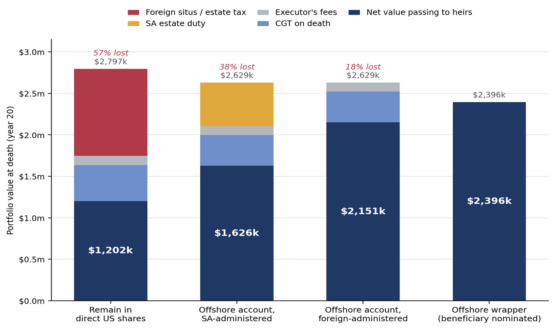
Figure 1: Estimated value passing to heirs at death, per structure (year 20)
Illustrative only. Assumes 8% p.a. growth (7.5% net of fund-level tax within the wrapper); CGT of $36 000 paid upfront on restructuring; US estate tax on the non-resident scale; executor’s remuneration at 3.5% plus Vat; estate duty at 20%; wrapper proceeds passing by beneficiary nomination with the policy continued. Tax interactions simplified.
Left where it is, the portfolio surrenders more than half of its value between Annelie’s death and her children receiving the money.
Restructured into a South African administered account, the foreign tax problem is solved but estate duty claws back a fifth of the capital that was previously exempt.
The foreign- administered account preserves the exemption and loses only executor’s fees and terminal CGT, while the wrapper (with a beneficiary nominated and the policy continued) passes the full amount, having already settled its tax along the way at fund level.
Why the best number is not always the best answer
And yet I did not simply recommend the wrapper, because the paper answer ignores a question that matters more than the arithmetic: where do the heirs live?
A policy issued into a South African-taxpaying policyholder fund is an excellent vehicle while both the owner and the eventual beneficiaries are South African residents.
It becomes far less so when a beneficiary lives abroad. Several jurisdictions look through these policies and tax them under their own rules and in some cases treating the proceeds as income in the beneficiary’s hands, in others deeming annual gains on a look-through basis and the result can be tax leakage in two countries at once.
Read: Going global: How offshore life plans simplify your estate and reduce tax
Annelie’s daughter has been living in Australia for six years and has no intention of returning. Wrapping the portfolio neatly for South African purposes while creating an annual tax headache for her daughter in Sydney would not have been good advice.
The result is a blended outcome. The portion of her offshore wealth destined for her son, who lives in Pretoria, went into the wrapper with him nominated as beneficiary.
The portion destined for her daughter went into the flexible account under the foreign nominee arrangement, to pass under her will, preserving the inheritance exemption and leaving her daughter to receive a clean capital asset rather than a foreign policy.
The broader lesson
Three points from this case apply to almost anyone holding offshore assets. First, an exemption in one country tells you nothing about your exposure in another.
The question is never simply ‘will Sars tax this?’ but ‘which revenue authority, anywhere in the world, has a claim on this asset when I die?’ Direct holdings of US and UK instruments are the most common blind spot I encounter.
Second, the source of your offshore money matters as much as its size. Funds you externalised yourself and funds you inherited from a non-resident are treated completely differently on death, and restructuring the latter carelessly can destroy an exemption that can’t be recreated.
Third, modern platform pricing allows investments to be split between products and moved between them as circumstances change, usually without additional platform cost.
Read: Timing matters: Retiring from your retirement annuity
The structure that suits you at 59 with two resident children may not suit you at 70 with one child abroad and it does not have to, provided the portfolio is reviewed with succession in mind rather than only performance.
Offshore investing solves the concentration problem of holding all of one’s wealth in a single small economy. But it introduces a structuring concern of its own, and the death taxes of other countries are unforgiving.
If a meaningful share of your wealth sits offshore and especially if any of it arrived by way of an inheritance from abroad, the time to test the structure is now, while every option is still open.
Even more so if you are the investor owning offshore wealth and planning on leaving it to your children.



 Megan joined the Brenthurst Wealth team in March 2026 as an Administrative and Fiduciary Services Assistant at our Val de Vie Office in the Western Cape. Prior to joining Brenthurst, Megan gained three years of experience in the retail sector, where she developed management and client service skills.


 I obtained my National Diploma in Financial Information Systems from the Cape Peninsula University of Technology in 1999 and have worked in the wealth management industry since January 2000. Over the years, I have gained extensive experience in various roles, including Portfolio Manager Assistant, Planner Assistant, and Paraplanner.
 Esmarelda Isaacs-Andreas joined the Brenthurst Wealth Stellenbosch office in October 2025, taking on the dual role of Receptionist and Fiduciary Administrator.
 I obtained my National Diploma in Financial Information Systems from the Cape Peninsula University of Technology in 1999 and have worked in the wealth management industry since January 2000. Over the years, I have gained extensive experience in various roles, including Portfolio Manager Assistant, Planner Assistant, and Paraplanner.
 Ashley joined Brenthurst Wealth in January 2025 as Office Administrative Assistant and Receptionist for the Stellenbosch Office.



 René Heystek joined Brenthurst Wealth in November 2023, as receptionist and administrative assistant in the newly established George/Garden Route office.
 Michelle Heystek has built a career in the financial services over the last two decades, after obtaining her B.Com degree in Financial Management in 2005. Once she joined Brenthurst in 2006, she continued her academic journey, obtaining her Certificate in Wealth Management from INSETA in 2007, followed by a Postgraduate Diploma in Financial Planning from the University of the Free State. In 2008, she earned the Certified Financial Planner (CFP®) designation.


 Anelle joined Brenthurst Wealth as a Receptionist and Administrative Assistant to Brian Butchart in the Cape Town office in December 2023. She has a wealth of knowledge from working as a liaison between Financial Advisers and clients at TMA and Absa Investment Management Services (Aims) since 1998. She obtained her B. com degree from the University of Port Elizabeth in 1997.


 ADMITTED ATTORNEY | FINANCIAL PLANNER & HEAD OF BRENTHURST FOURWAYS

 Sanet was appointed in April 2020, joining our Cape Town team as an Executive Administration Assistant to Renee Eagar. She has been in the financial services industry since 1990. Her previous experience includes positions at Sanlam, BJM and ABSA. She spent her last 12 years working at Alexander Forbes Private Client Wealth as a Senior Wealth Management Assistant. She has received numerous accolades over the years which include but not limited to, Alexander Forbes Client Service Excellence – Silver award in 2014,2015 and 2017. Sanet has also obtained her Certificate in Wealth Management (NQF 5) in 2012 and achieved “Best Student of the Year” from Moonstone.


 Maria Smit is a Certified Financial Planner® with over 10 years of experience in the financial planning industry.