
The simple answer – in the short term, it doesn’t matter!
For years, this debate has been fiercely fought, with punters on both sides of the equation. Each side of the debate has its smartest financial models, arguments, and technical and fundamental analysis to prove they were indeed right, at least at some stage in the period below. ($/R)
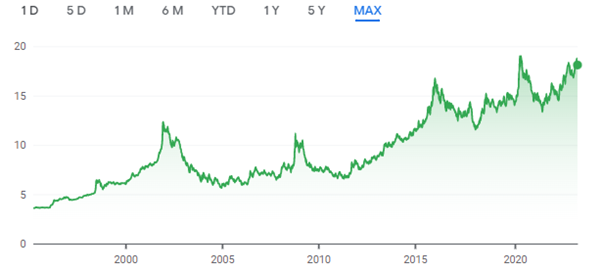
But for all currency punters and watchmen of the financial markets, it is no new news that trying to predict the rand-dollar, or the rand against any other currency for that matter in the short term is a fool’s game. You have a better chance of betting on Ireland winning the Rugby World Cup in France in 2023 than punting on the short-term future of the rand. It is close to impossible, as I said, especially in the shorter term.
Speaking of rugby, you would not be far off in comparing the rand to a team such as perhaps the Italians, and the major currencies (dollar/euro/pound) to the likes of the mighty All Blacks or the force of the Boks. Both are vital role players in the bigger scheme of things, but there will always be one winner come the big stage.
The US economy proved to be somewhat stronger (than expected) in the first quarter of 2023. This implies that further interest rate hikes are on the cards from the Americans, which does not bode well for South Africa, as we seem to blindly follow in their footsteps. The labour market in the US economy remains resilient. It is very likely that rates might be increased by 0.50% increments in the next couple of Fed meetings, and rates will most likely remain higher for longer.
Even though US inflation started to gradually decrease from 9.10% in the second quarter of 2022 to roughly 6% in the first quarter of 2023, the Fed is not yet necessarily happy with these numbers and would like to bring inflation down faster and more aggressively. The Fed will do whatever it deems necessary to bring inflation under control.
This means that there is all likelihood that the dollar could remain stronger for longer. But as mentioned, timing this in the short term is a fool’s errand.
The biggest global factors influencing the rand-dollar exchange rate:
- US and local interest rates;
- Eskom and load shedding’s impact on the SA economy;
- Greylisting of SA to a certain extent; and
- SA’s balance of payments.
One of the main reasons why it is extremely difficult to accurately predict the rand’s forecast against the major currencies globally is that the rand is a floating currency, meaning that the underlying value of the rand will be influenced by global economic events in foreign markets. Hundreds of other aspects are also claiming their toll on the rand daily, which makes it impossible to predict the direction of the currency.
Rugby World Cup and currencies? How? Why?
It is 2023. Four years have passed since the Springboks became World Champions for the third time in history. 1995, 2007, and once again the memorable tournament in Japan in 2019, which the Boks won against all odds.
A full 28 years since we lifted the holy grail of rugby – the coveted William Web Ellis Trophy at Ellis Park in 1995, against the All Blacks.
In between, the All Blacks also managed to lift the trophy three times. The English Roses also had a singular opportunity to claim bragging rights. Therefore, it is difficult to predict a winner in these tournaments. But keep in mind – there will always be one winner.
In all brutal honesty, 1995 was about the only chance for roughly 99% of South Africans to watch the Rugby World Cup live at a stadium because ever since all tournaments were played on foreign soil, and unfortunately, our exchange rate replicated the performance of the Italians in a Rugby World Cup ever since. Not much to write home about.
In 2007, the Boks travelled to Paris to claim the trophy back, and the rand/dollar and rand/euro traded at the following levels:
- Dollar-rand: $1: R7.20
- Euro-rand: €1: R9.50
A ticket getting you into the final at the time would have broken the bank at €200. Cheap, upper-stand seats behind the poles, but you are there to witness our moment of glory.
This means that a ticket would have cost you roughly R1 800 – R2 000. Fast forward 16 years, and we are once again heading to France, this time to defend our title as world champions. Should you wish to pack down in the stands this year, and a ticket would come in yet again at €200 (which will obviously be more expensive than 16 years ago), you would cough up R3 900 – R4 500.
Let’s adjust for annual inflation on these tickets over 16 years at a mere 4%, the damage would be as follow:
€375 at an exchange rate of about R19.60 to the euro, therefore, this ticket will put you out of pocket at an estimate of R7 300.
The reason I painted this picture, was to put an actual example in context as to what direct impact the devaluation of our currency will have on South African consumers of global products and services. Not every second South African will have the need or means to hop on a plane to watch the Rugby World Cup every four years, but the fact remains that we are worldwide consumers, especially of big-ticket items when it comes to the tech devices we so often use, the vehicles we drive, clothes we wear, etc.
When faced with the decision to take capital offshore for long-term investment purposes, a small diversion in the rand to other currencies should not be a deterring factor in deciding against it, mostly for the reasons explained above.
This is a very simple and short example of why timing the rand is close to impossible, but, over the long run, there will always be one winner and an even more certain loser…
Here’s why:
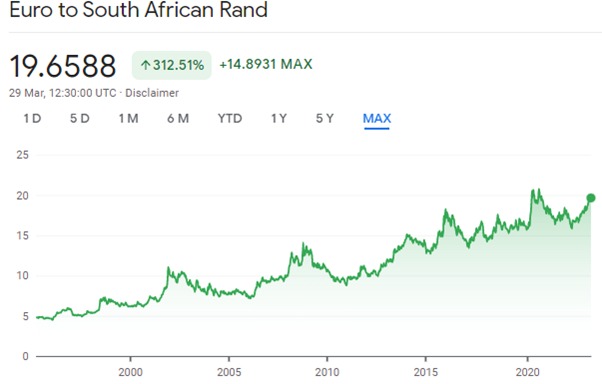
Come the Rugby World Cup 2023, there will once again be thousands of South Africans who would like to travel to Paris to watch the Green and Gold claim their stake, but unfortunately, most of them will be forced to watch this big event from the comfort of their living rooms or around the braai in their lapas as more and more locals have become poorer and poorer in global terms over the last decade.
Do not expect less volatility from the rand in the short term, but most definitely do not expect these graphs above to change in trajectory going forward. The next World Cup in 2027 will be no different and no cheaper. Put your capital in a position to take you there, or at the very least, enable you to afford your lifestyle in SA. Don’t put your money on the Italians, it will be safer on the Kiwis or SA’s warriors!


 Megan joined the Brenthurst Wealth team in March 2026 as an Administrative and Fiduciary Services Assistant at our Val de Vie Office in the Western Cape. Prior to joining Brenthurst, Megan gained three years of experience in the retail sector, where she developed management and client service skills.


 I obtained my National Diploma in Financial Information Systems from the Cape Peninsula University of Technology in 1999 and have worked in the wealth management industry since January 2000. Over the years, I have gained extensive experience in various roles, including Portfolio Manager Assistant, Planner Assistant, and Paraplanner.
 Esmarelda Isaacs-Andreas joined the Brenthurst Wealth Stellenbosch office in October 2025, taking on the dual role of Receptionist and Fiduciary Administrator.
 I obtained my National Diploma in Financial Information Systems from the Cape Peninsula University of Technology in 1999 and have worked in the wealth management industry since January 2000. Over the years, I have gained extensive experience in various roles, including Portfolio Manager Assistant, Planner Assistant, and Paraplanner.
 Ashley joined Brenthurst Wealth in January 2025 as Office Administrative Assistant and Receptionist for the Stellenbosch Office.


 René Heystek joined Brenthurst Wealth in November 2023, as receptionist and administrative assistant in the newly established George/Garden Route office.
 Michelle Heystek has built a career in the financial services over the last two decades, after obtaining her B.Com degree in Financial Management in 2005. Once she joined Brenthurst in 2006, she continued her academic journey, obtaining her Certificate in Wealth Management from INSETA in 2007, followed by a Postgraduate Diploma in Financial Planning from the University of the Free State. In 2008, she earned the Certified Financial Planner (CFP®) designation.


 Anelle joined Brenthurst Wealth as a Receptionist and Administrative Assistant to Brian Butchart in the Cape Town office in December 2023. She has a wealth of knowledge from working as a liaison between Financial Advisers and clients at TMA and Absa Investment Management Services (Aims) since 1998. She obtained her B. com degree from the University of Port Elizabeth in 1997.


 ADMITTED ATTORNEY | FINANCIAL PLANNER & HEAD OF BRENTHURST FOURWAYS

 Sanet was appointed in April 2020, joining our Cape Town team as an Executive Administration Assistant to Renee Eagar. She has been in the financial services industry since 1990. Her previous experience includes positions at Sanlam, BJM and ABSA. She spent her last 12 years working at Alexander Forbes Private Client Wealth as a Senior Wealth Management Assistant. She has received numerous accolades over the years which include but not limited to, Alexander Forbes Client Service Excellence – Silver award in 2014,2015 and 2017. Sanet has also obtained her Certificate in Wealth Management (NQF 5) in 2012 and achieved “Best Student of the Year” from Moonstone.


 Maria Smit is a Certified Financial Planner® with over 10 years of experience in the financial planning industry.


