By Gustav Reinach – Brenthurst Wealth
A common misconception about diversification is that simply spreading risk across multiple asset classes is enough.
One of the most important goals for any investor is to avoid losing money, which can be achieved easily enough if you lower your risk. However, investing only in low-risk assets will deliver below-par performance and possibly lead you to miss your investment goals.
This is why you will hear advisors repeating the same thing over and over, diversify!
What this does is spread risk across different asset classes so that, if done properly, one asset class will outperform when others underperform.
Take this example of the difference in how two different funds have performed between February 2014 to end of January 2022.
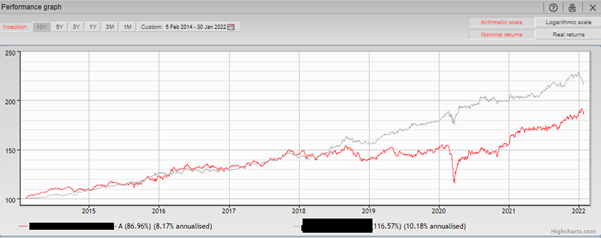
The grey line represents the returns of a fund that has 50% exposure to international equities, whereas the red line is that of a fund with 50%-60% exposure to SA Equities. With outperformance of 27% of the SA-focused fund, the benefits of diversifying offshore have been hugely beneficial. On a R1 million investment, this is R270 000 of outperformance.
Different strokes
A common misconception about diversification is that simply spreading risk across multiple asset classes is enough.
However, every portfolio and diversification strategy will differ based on each individual investor’s needs and priorities. And crucially, the investor’s investment horizon.
I believe that if you have 10 or more years before you need your capital then there is no reason you should not be invested 100% in equities.
Your diversification strategy in such an instance would then focus on different sectors or themes, as well as different geographies. As the above graph illustrates, having merely 50% of a portfolio invested in offshore markets produced remarkable outperformance over locally focused strategies.
The closer you are to retirement, the less risk you want to take in case markets hit a speed bump. This can have a disastrous impact on your investments if you do not have sufficient time before retirement for prices to recover.
I recommend that if you are five or fewer years from retirement that you start tapering down your exposure to equities to the point that you have about 70% of your portfolio in cash and bonds.
Shorter investment horizons – if, say, you are saving for a deposit to buy a house in three years – then you would also want to diversify your portfolio. Once again, I suggest a maximum of 30% in equities and the remainder in cash and bonds.
Diversification within asset classes
As already mentioned, 100% exposure to one asset class, like equities, makes sense under certain conditions. The times it makes the most sense is when you still have a long investment horizon that will allow you to recover if the market dips.
Apart from diversifying across sectors, you can get further diversification by looking offshore. I believe that this is essential for South African investors to produce long-term outperformance.
The wider scope of investments and investment opportunities outside of the country, alone, is reason to spread your risk across borders.
Do not discount SA bonds
I am certainly not advocating that you abandon all local assets, because there is still value to be found. Particularly in local bonds.
SA bonds are worth consideration because, in real terms, they deliver the best yields for what is a conservative asset class. In addition, they are a great combination with offshore equities because they are negatively correlated.
This delivers the ideal counterbalance in a portfolio that ends up giving the investor a smoother ride over the longer term.
Money market and cash
Conservative assets like cash and money market investments are less popular because of the effect of inflation eating into capital.
It makes sense to have some liquidity in local currency if that suits your lifestyle, but I would suggest holding no more than 8% – 10% of your portfolio in cash. Having cash on hand also presents the opportunity to profit from cheaper-priced equities if there is a big market correction.
If you are inclined that way you might want to hold aside liquidity to take a punt on occasional opportunities. This approach does not suit everyone but does allow the more adventurous investor to keep money available to invest without the fear of upsetting the entire portfolio with a long shot side bet.


 Megan joined the Brenthurst Wealth team in March 2026 as an Administrative and Fiduciary Services Assistant at our Val de Vie Office in the Western Cape. Prior to joining Brenthurst, Megan gained three years of experience in the retail sector, where she developed management and client service skills.


 I obtained my National Diploma in Financial Information Systems from the Cape Peninsula University of Technology in 1999 and have worked in the wealth management industry since January 2000. Over the years, I have gained extensive experience in various roles, including Portfolio Manager Assistant, Planner Assistant, and Paraplanner.
 Esmarelda Isaacs-Andreas joined the Brenthurst Wealth Stellenbosch office in October 2025, taking on the dual role of Receptionist and Fiduciary Administrator.
 I obtained my National Diploma in Financial Information Systems from the Cape Peninsula University of Technology in 1999 and have worked in the wealth management industry since January 2000. Over the years, I have gained extensive experience in various roles, including Portfolio Manager Assistant, Planner Assistant, and Paraplanner.
 Ashley joined Brenthurst Wealth in January 2025 as Office Administrative Assistant and Receptionist for the Stellenbosch Office.


 René Heystek joined Brenthurst Wealth in November 2023, as receptionist and administrative assistant in the newly established George/Garden Route office.
 Michelle Heystek has built a career in the financial services over the last two decades, after obtaining her B.Com degree in Financial Management in 2005. Once she joined Brenthurst in 2006, she continued her academic journey, obtaining her Certificate in Wealth Management from INSETA in 2007, followed by a Postgraduate Diploma in Financial Planning from the University of the Free State. In 2008, she earned the Certified Financial Planner (CFP®) designation.


 Anelle joined Brenthurst Wealth as a Receptionist and Administrative Assistant to Brian Butchart in the Cape Town office in December 2023. She has a wealth of knowledge from working as a liaison between Financial Advisers and clients at TMA and Absa Investment Management Services (Aims) since 1998. She obtained her B. com degree from the University of Port Elizabeth in 1997.


 ADMITTED ATTORNEY | FINANCIAL PLANNER & HEAD OF BRENTHURST FOURWAYS

 Sanet was appointed in April 2020, joining our Cape Town team as an Executive Administration Assistant to Renee Eagar. She has been in the financial services industry since 1990. Her previous experience includes positions at Sanlam, BJM and ABSA. She spent her last 12 years working at Alexander Forbes Private Client Wealth as a Senior Wealth Management Assistant. She has received numerous accolades over the years which include but not limited to, Alexander Forbes Client Service Excellence – Silver award in 2014,2015 and 2017. Sanet has also obtained her Certificate in Wealth Management (NQF 5) in 2012 and achieved “Best Student of the Year” from Moonstone.


 Maria Smit is a Certified Financial Planner® with over 10 years of experience in the financial planning industry.