*This content is brought to you by Brenthurst Wealth
By Charize Beukes*
When planning for retirement, it’s easy to feel overwhelmed by all the investment options that you hear you could or should be using. It doesn’t help that the world around us seems to be getting crazier, which affects how we think about and plan for the future.
And how do you plan for the future when it seems that market conditions and the future outlook changes every other day?

The tortoise and the hare of investing
Remember the story of the tortoise and the hare? The hare was fast and flashy but didn’t win the race. The tortoise moved slowly and steadily and came out ahead.
Translated into investment strategies, the rabbit can be compared to growth stocks that are exciting and full of promise, but also very volatile. The tortoise, on the other hand is like value stocks: less thrilling but reliable over the long haul.
Understanding these concepts can help you understand the value of each, and how you can use them grow your nest egg.
What are value stocks?
Value stocks are shares of companies that are solid and established but currently priced lower than what they’re really worth. Think of them as items on sale at your favourite shop—you get quality products without paying full price.
These stocks offer stable growth because these companies might not grow rapidly but have a track record of steady performance. Many value stocks pay dividends, which means you get regular income just for holding the shares. They tend to have fewer dramatic price swings, making them a calmer choice for long-term investors.
What are growth stocks?
Growth stocks are companies that are expected to grow faster than others. They might be newer or part of booming industries like technology – many of the big tech stocks fall into this category. While they offer the potential for bigger gains, they’re also more unpredictable.
These stocks carry higher risk because their prices can rise quickly but can also fall just as fast. They often reinvest earnings back into the business instead of paying dividends, so you won’t receive regular pay outs.
And they’re more affected by economic changes, which can lead to greater volatility.
The following graph shows that over the past 10 years, growth stocks did indeed produce higher returns over the long term. However, that graph line also highlights how much more volatile growth stocks are compared to value stocks.
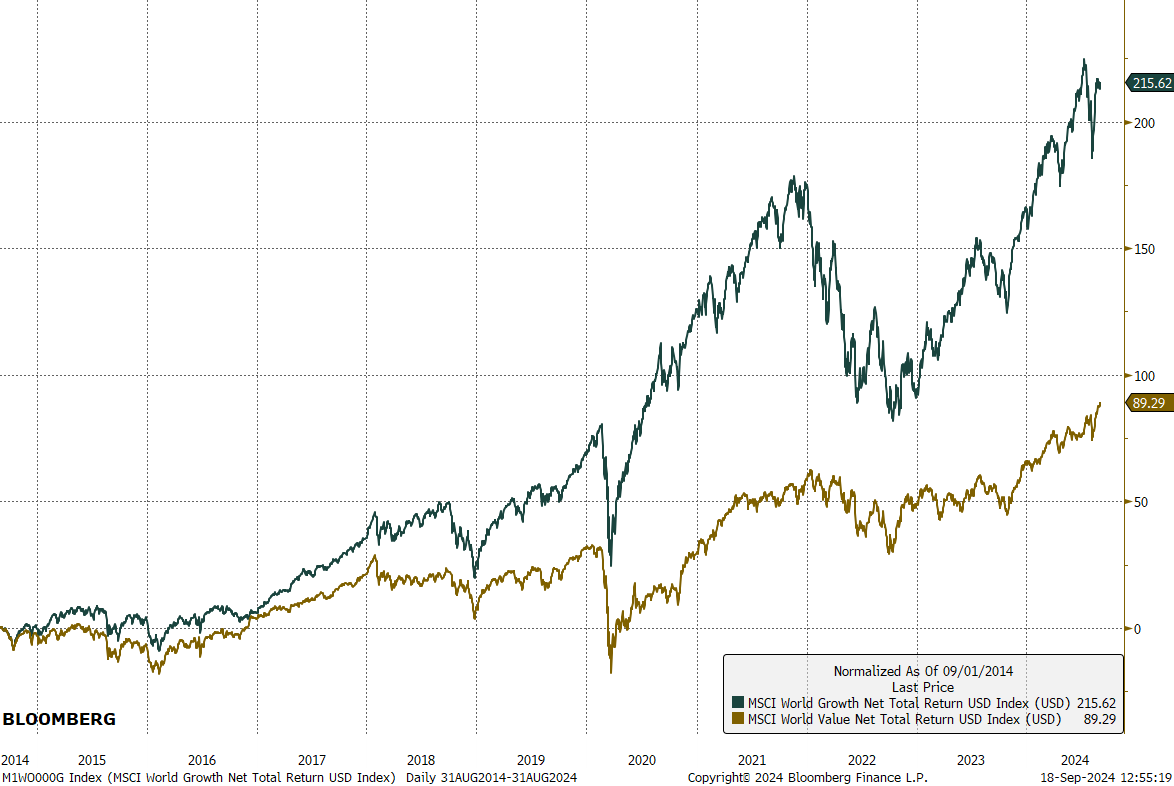
Period: 10-Years
MSCI World Growth Index (% TR USD)
MSCI World Value Index (% TR USD)
The impact of lower interest rates
In the past week, the Reserve Bank and US Federal Reserve finally started to lower interest rates. This shift can affect both growth and value stocks in different ways.
Growth companies often borrow money to expand. Lower interest rates mean it’s cheaper for them to get loans, which can help them grow faster. When interest rates are low, future profits are worth more in today’s terms, making growth stocks more attractive to investors.
With lower interest rates, the returns on savings accounts and bonds decrease. This can make the steady dividends from value stocks more appealing to conservative investors.
Why a steady approach still matters for retirement
Even with interest rates decreasing, a steady investment approach remains important. Value stocks can offer more consistency and reduced volatility, providing a sense of stability, particularly for investors with lower risk tolerance. While growth stocks may outperform value stocks over the long term, they tend to be more volatile and are better suited to those with a higher tolerance for risk.
Dividends from value stocks may offer a regular income stream, which can be beneficial during retirement, though different strategies work for different needs.
It’s essential to remember that investing is not about chasing short-term trends or quick gains. While the current lower interest rates may make growth stocks appear more attractive, they can also carry higher risks, thus making it imperative to maintain a balance between growth and value.
Consulting your financial adviser is recommended to ensure your portfolio is balanced appropriately for your individual situation. A diversified mix of growth and value stocks is essential, though the ideal balance depends on your unique goals and financial circumstances.
And remember saving for retirement is a marathon, not a sprint. Lower interest rates can influence the stock market positively, but sticking with a prudent, steady approach is more likely to help you build a solid financial foundation. “Investing isn’t just about how high you can fly, but how smooth the ride is along the way.”
Ultimately, the goal is to enjoy your retirement years without financial worries. Slow and steady might win the race for you, too.
* Charize Beukes, CFP® is a financial advisor at Brenthurst Wealth Pretoria.


 Megan joined the Brenthurst Wealth team in March 2026 as an Administrative and Fiduciary Services Assistant at our Val de Vie Office in the Western Cape. Prior to joining Brenthurst, Megan gained three years of experience in the retail sector, where she developed management and client service skills.


 I obtained my National Diploma in Financial Information Systems from the Cape Peninsula University of Technology in 1999 and have worked in the wealth management industry since January 2000. Over the years, I have gained extensive experience in various roles, including Portfolio Manager Assistant, Planner Assistant, and Paraplanner.
 Esmarelda Isaacs-Andreas joined the Brenthurst Wealth Stellenbosch office in October 2025, taking on the dual role of Receptionist and Fiduciary Administrator.
 I obtained my National Diploma in Financial Information Systems from the Cape Peninsula University of Technology in 1999 and have worked in the wealth management industry since January 2000. Over the years, I have gained extensive experience in various roles, including Portfolio Manager Assistant, Planner Assistant, and Paraplanner.
 Ashley joined Brenthurst Wealth in January 2025 as Office Administrative Assistant and Receptionist for the Stellenbosch Office.


 René Heystek joined Brenthurst Wealth in November 2023, as receptionist and administrative assistant in the newly established George/Garden Route office.
 Michelle Heystek has built a career in the financial services over the last two decades, after obtaining her B.Com degree in Financial Management in 2005. Once she joined Brenthurst in 2006, she continued her academic journey, obtaining her Certificate in Wealth Management from INSETA in 2007, followed by a Postgraduate Diploma in Financial Planning from the University of the Free State. In 2008, she earned the Certified Financial Planner (CFP®) designation.


 Anelle joined Brenthurst Wealth as a Receptionist and Administrative Assistant to Brian Butchart in the Cape Town office in December 2023. She has a wealth of knowledge from working as a liaison between Financial Advisers and clients at TMA and Absa Investment Management Services (Aims) since 1998. She obtained her B. com degree from the University of Port Elizabeth in 1997.


 ADMITTED ATTORNEY | FINANCIAL PLANNER & HEAD OF BRENTHURST FOURWAYS

 Sanet was appointed in April 2020, joining our Cape Town team as an Executive Administration Assistant to Renee Eagar. She has been in the financial services industry since 1990. Her previous experience includes positions at Sanlam, BJM and ABSA. She spent her last 12 years working at Alexander Forbes Private Client Wealth as a Senior Wealth Management Assistant. She has received numerous accolades over the years which include but not limited to, Alexander Forbes Client Service Excellence – Silver award in 2014,2015 and 2017. Sanet has also obtained her Certificate in Wealth Management (NQF 5) in 2012 and achieved “Best Student of the Year” from Moonstone.


 Maria Smit is a Certified Financial Planner® with over 10 years of experience in the financial planning industry.